

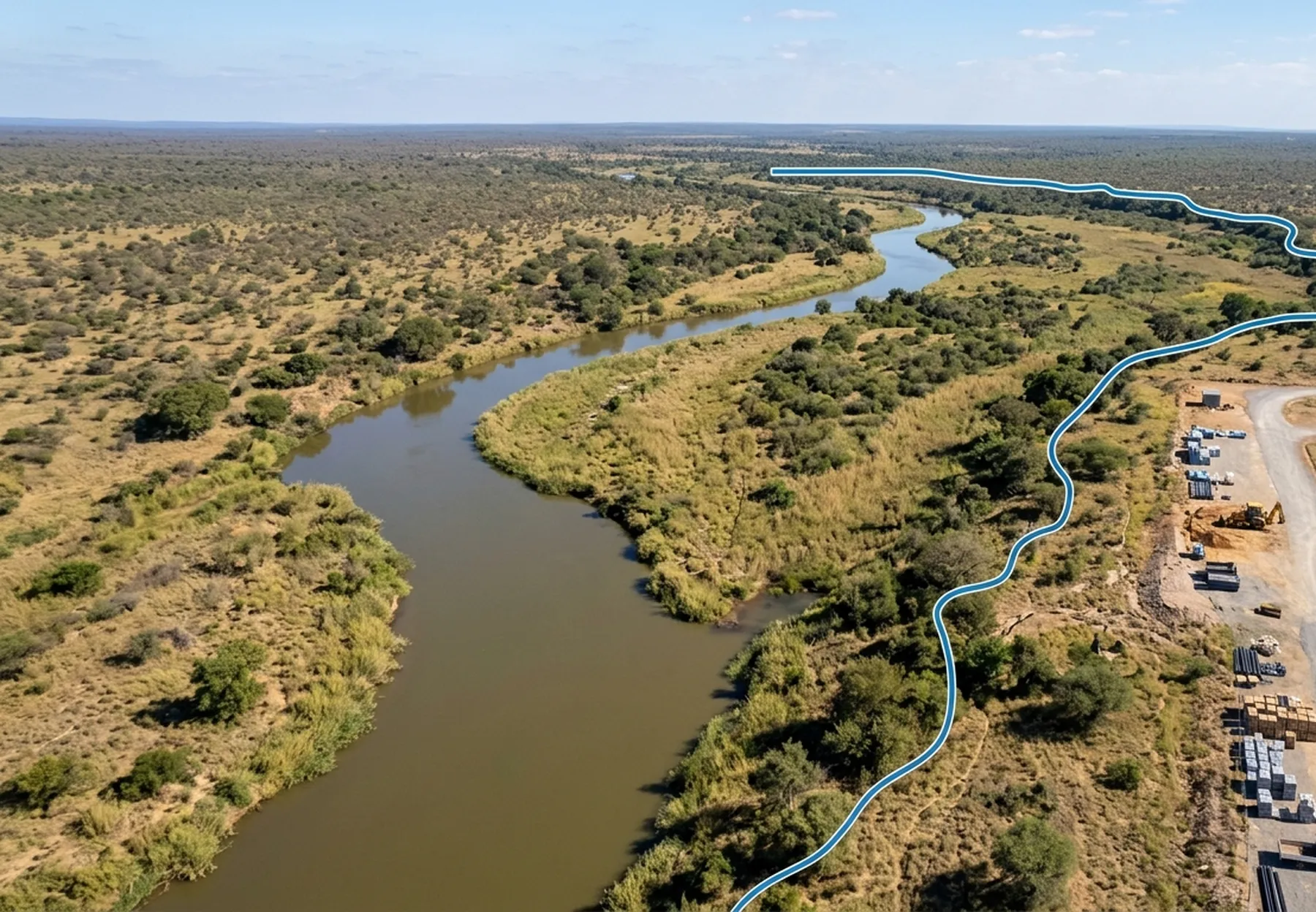
Floodline Determination in South Africa: What You Need to Know
· Written by Robert Fortuin
If you are developing land near a watercourse, wetland, canal, or low-lying drainage line, a floodline determination is often the technical backbone of a South African planning submission. Done well, it links rainfall and catchment response to mapped flood extents, and then translates that into practical constraints for building platforms, road levels, crossings, service corridors, and stormwater outfalls.
This guide is written for SA projects (developers, municipalities, mines, and consulting engineers) and focuses on what typically causes rework: unclear scope, missing data, wrong design events, or a “pretty plan” without traceability.
Developing near a watercourse, wetland, or drainage line? We scope floodline determinations around the four things that actually cause rework — so the study lands right the first time.
Floodline determinationWhy municipalities ask for floodlines
Floodlines translate a design storm (or design flow) into mapped depths, velocities, and extents. Where a watercourse or wetland is involved, this sits alongside the Department of Water and Sanitation’s regulatory interest in the resource itself. Municipal reviewers use them to:
- Protect people and assets from predictable flood hazards.
- Avoid placing development platforms where water will pond or overtop in frequent events.
- Ensure roads, culverts, bridges, and outfalls don’t export risk downstream.
- Preserve river corridors, wetlands, and maintenance access routes.
In practice, a “floodline” request is rarely just one line. Authorities commonly expect a set of events and clear guidance on freeboard, building setbacks, and crossing conditions.
When floodlines are triggered (common SA scenarios)
Floodline requirements vary by municipality and project type, but in South Africa they are commonly triggered by:
- Rezoning, subdivisions, township establishment, and departures near a watercourse.
- Any development within (or adjacent to) mapped flood-prone land or wetlands.
- Bulk earthworks that change flow paths, ponding, or flood storage.
- New/expanded crossings (culverts/bridges) on public or private roads.
- Channelisation, berming, diversion drains, or formalised stormwater outfalls.
- Mine water infrastructure (dams, diversions, pollution control dams, return water dams) where downstream consequence is a key risk.
What a strong brief includes
Give your engineer enough to define the right model and the right events from day one:
- Site package: survey (incl. spot levels/contours), SG diagram, erf boundaries, and a layout concept with platform levels (if available).
- Known constraints: servitudes, wetlands/riparian delineations, existing pipes/channels, bridges/culverts, and utility corridors.
- Authority context: the specific municipality/department contact, any pre-application notes, and the submission purpose (planning vs detailed design).
- Existing hydrology/drainage work: prior flood studies, geotech reports noting seepage/groundwater, as-builts for nearby stormwater infrastructure, and any river maintenance constraints.
- Photos and local knowledge: high-water marks, erosion points, blocked culverts, resident observations, and timing (summer thunderstorm vs winter frontal rainfall regions).
- The “what if” list: layout alternatives, proposed crossing locations, and what must remain buildable if constraints tighten.
Local conditions that materially change the answer
Two SA sites can have the same area and slope but very different flood behaviour. A credible brief flags the drivers early:
- Rainfall regime: summer convective storms (e.g. Gauteng/Highveld) behave differently to winter frontal rainfall (e.g. Western Cape) and mixed regimes along the coast.
- Alluvial rivers vs flashy urban catchments: sediment transport, backwater, and debris behaviour can dominate in one case, while inlet control and surcharge dominate in another.
- Cape Flats / low-gradient sands: shallow slopes and high groundwater can make ponding and outlet tailwater more critical than peak flow alone.
- Steep coastal catchments: short concentration times, debris, and culvert blockage risk can control crossing performance.
- Informal modifications: small berms, driveways, yard walls, and private “diversion drains” can cause large local impacts in low-gradient areas.
What design events should be assessed?
Authorities often ask for a particular “floodline” event (frequently the 1:100 year), but a design should also check more frequent storms to understand nuisance flooding and operational risk. Your engineer should confirm the event set with the reviewer, but a typical event suite might include:
- Frequent storms (for ponding and access): (1:2), (1:5), (1:10)
- Planning/design benchmark: (1:50), (1:100) (commonly requested)
- Critical infrastructure checks: larger events or sensitivity runs where consequence is high
The key is not the exact list—it’s that the report clearly states why each event is included and how it is used in the planning decision.
What modelling approach is appropriate?
Floodline studies are not one-size-fits-all. A good report motivates the approach and its limits:
- Hydrology: how design rainfall is selected, losses are treated, and catchment response is computed (including sensitivity to catchment boundaries and urbanisation).
- Hydraulics: whether 1D, 2D, or coupled modelling is needed, and how structures (culverts/bridges/weirs) are represented.
- Topography: reliance on survey vs public DEMs; how channels, roads, and walls are treated; and what uncertainty that introduces.
- Tailwater and backwater: estuaries, major rivers, canals, or stormwater trunks can control flood levels far upstream.
- Blockage and debris: where relevant, demonstrate how blockage risk is considered (even if via sensitivity cases rather than a single “blocked” assumption).
What you should expect in deliverables
Expect more than a coloured plan. A reviewer-ready package usually includes:
- Assumptions + scope summary: what was included/excluded and why.
- Method statement: hydrology method choices, hydraulic model approach, and sensitivity checks.
- Evidence: calibration logic (where possible), reasonableness checks, and structure performance notes.
- Mapping (GIS/CAD-ready): flood extents per event, depth/velocity (where relevant), and clearly labelled hazard zones.
- Constraints for the layout: recommended setbacks, building platform guidance, freeboard notes, and crossing requirements.
- Appendices: inputs, key parameters, model build notes, and enough detail for peer review.
A simple test: will your floodline survive review?
Before submission, ask:
- Can we trace every key input (rainfall, catchment area, roughness, structure sizes) to a source?
- Are the event definitions explicit (AEP/return period, duration strategy, climate region context)?
- Do the outputs link to decisions (platform levels, setbacks, crossings), not just maps?
- Are limitations stated honestly (survey gaps, DEM limits, structure uncertainty)?
If those answers are “yes”, your floodline determination is far more likely to move through review without painful redesign cycles.
Sources & further reading
- National Water Act 36 of 1998 — the legislation governing watercourse regulation in South Africa.
Working on a site where flooding, stormwater, or floodlines are a concern? Send us a message about it and we’ll reply within one business day — no obligation.
Talk to an engineer