
Delta Hydro · South Africa
Flood Risk Intelligence Flood maps, flood risk assessments and consulting for South Africa
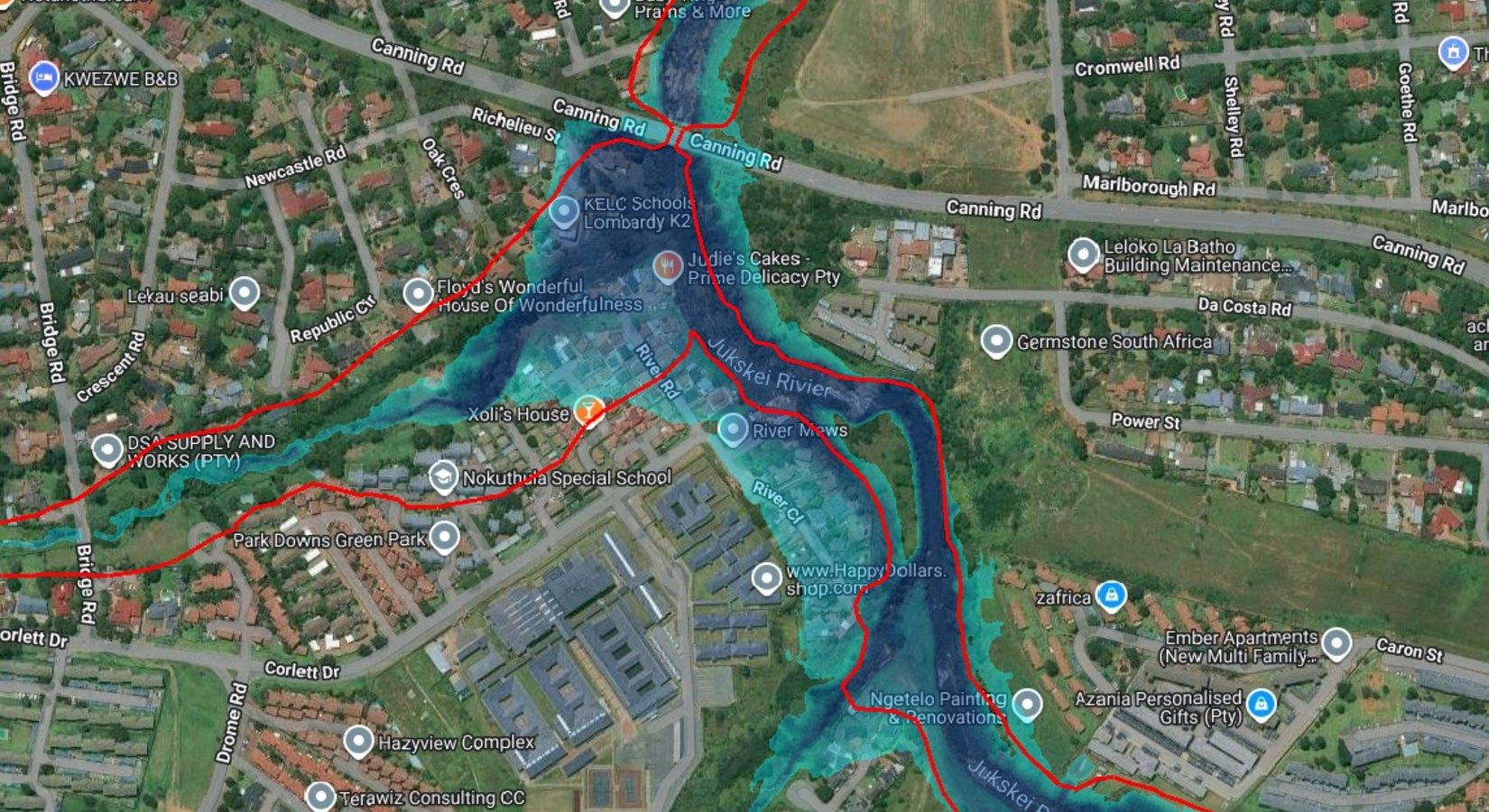
Delta Hydro is a South African flood engineering firm. We build flood models from local rainfall and stream gauge records on 5 m terrain, and supply the results as flood maps, risk assessments and engineering advice to insurers, lenders, developers, municipalities and infrastructure owners.
- National terrain model, GeoSmart FUSEDEM
- 5 m
- LiDAR terrain where it is available
- 1 m
- Year return periods, as required
- 1:2 to 1:1 000
- Hydraulic models, as used for regulatory floodline studies
- 2D
What we supply
-
01
Flood Maps
Flood extent, depth, velocity and hazard for any area of South Africa, at the return periods you need.
-
02
Flood Risk Assessments
Flood risk and estimated loss for a single site or a whole portfolio, with a report and the data behind it.
-
03
Consulting
Floodline studies, flood mitigation and stormwater design, dam break assessments and expert reports.
Who we work with: insurers, reinsurers and brokers, banks and lenders, property developers, municipalities, roads agencies, and owners of utility, rail, mining and property assets.
Local rainfall, local gauges, 5 m terrain
Flood risk data built in South Africa
South African engineering consultancies have produced floodlines for individual towns, developments and rivers for decades. The flood risk data products that cover the whole country, however, are almost all global products. These are built from large international datasets: satellite terrain at around 30 m, rainfall estimated from global records, and no calibration against South African rivers. They give a first view of a country, but they do not resolve the terrain, the road crossings or the storm patterns that decide which properties flood here.
Delta Hydro is the first South African company to produce national flood risk data from local rainfall records and stream gauge data. Our models run on GeoSmart's 5 m FUSEDEM terrain model, with 1 m LiDAR where it is available. We combine current 2D hydraulic models with machine learning and custom in-house tools, so that the method we use for a regulatory floodline study can be applied across whole catchments and portfolios.
Why terrain resolution matters
Modderfontein Spruit, Johannesburg
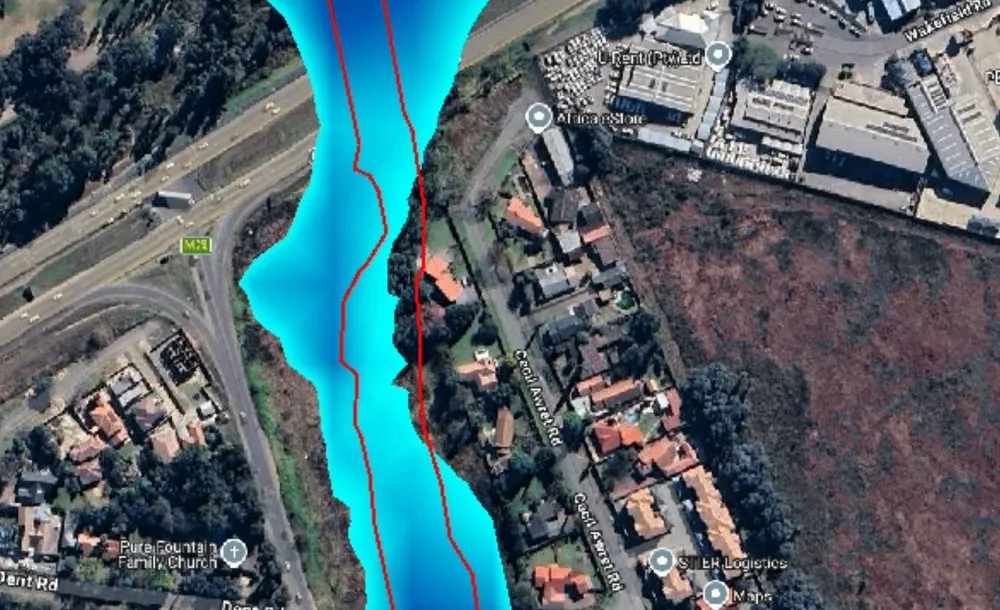 Model on 30 m satellite terrain
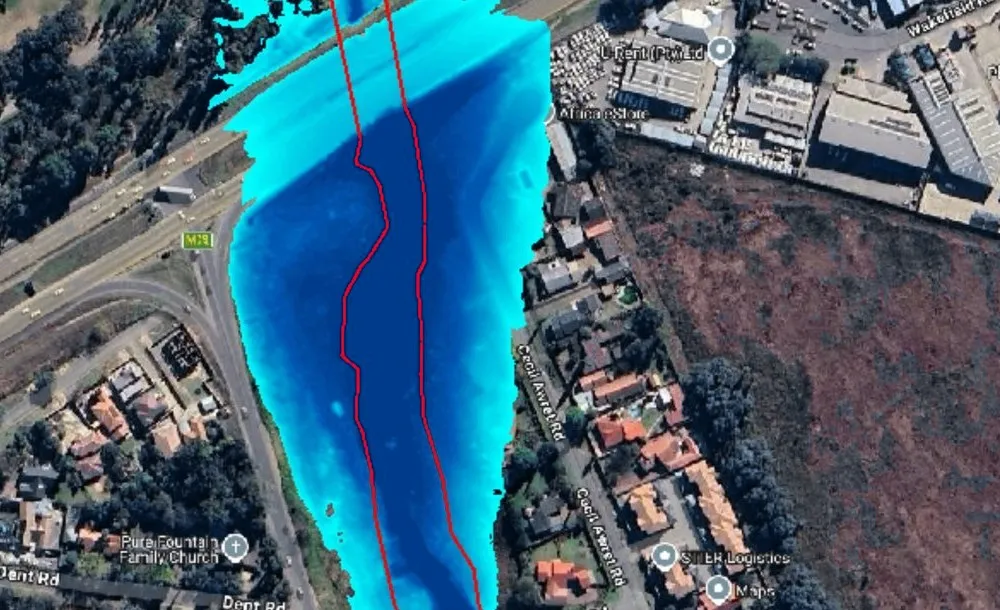 Delta Hydro model on 1 m LiDAR
Flood model specification
| Perils | River and surface water (pluvial) flooding. Coastal flooding is in development. |
|---|---|
| Return periods | 1:2 to 1:1 000-year, as required. |
| Climate change | Future rainfall scenarios modelled on request. |
| Terrain | GeoSmart 5 m FUSEDEM nationally; 1 m LiDAR where available. |
| Rainfall | South African design rainfall and SAWS station records. |
| Calibration | DWS stream gauge records. |
| Method | 2D hydraulic models, machine learning and in-house tools. |
| Structures | Bridges, culverts and embankments in the hydraulics. |
| Outputs | Flood extent, depth, velocity, water level and hazard class. |
| Formats | GeoTIFF, GeoPackage, shapefile and CSV; API; Delta Hydro platform. |
| Coordinates | Hartebeesthoek94, Lo or UTM. |
Coverage: any area of South Africa
We cover the whole of South Africa. Flood maps already exist for parts of Gauteng. Where a client needs flood data for an area we have not yet modelled, we model it, check it and deliver it; the lead time depends on the size of the area and the number of structures in it. Every map passes a set of automated checks before release: flood depths that increase with return period, volume balance within tolerance, and a stated coordinate system and data version.
Every result carries its provenance. Each flood depth, score and loss estimate is tagged with the model run, the terrain and rainfall data versions and the date it was produced, so your risk, audit and actuarial teams can trace any number back to its source.
Bridges, culverts and embankments
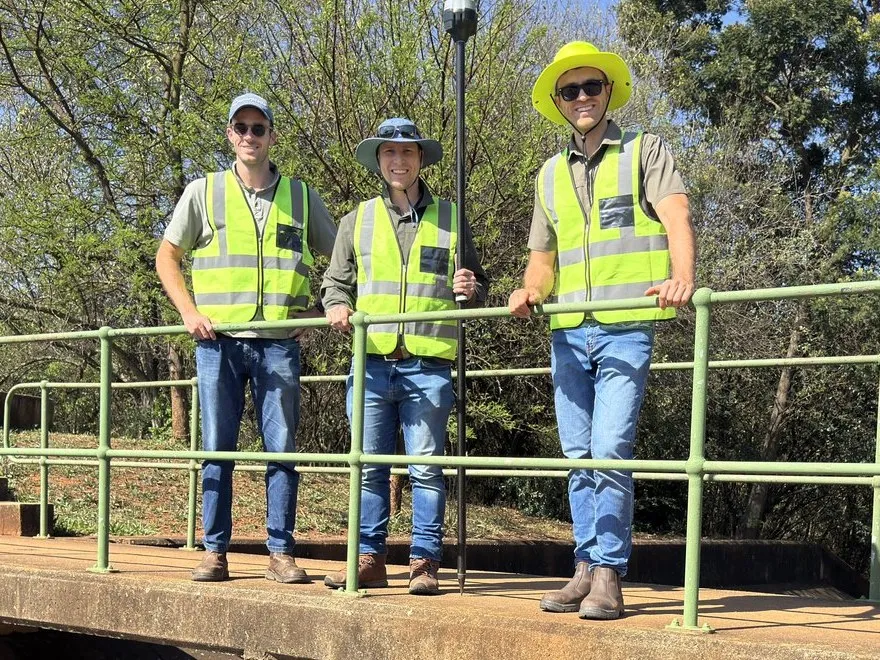
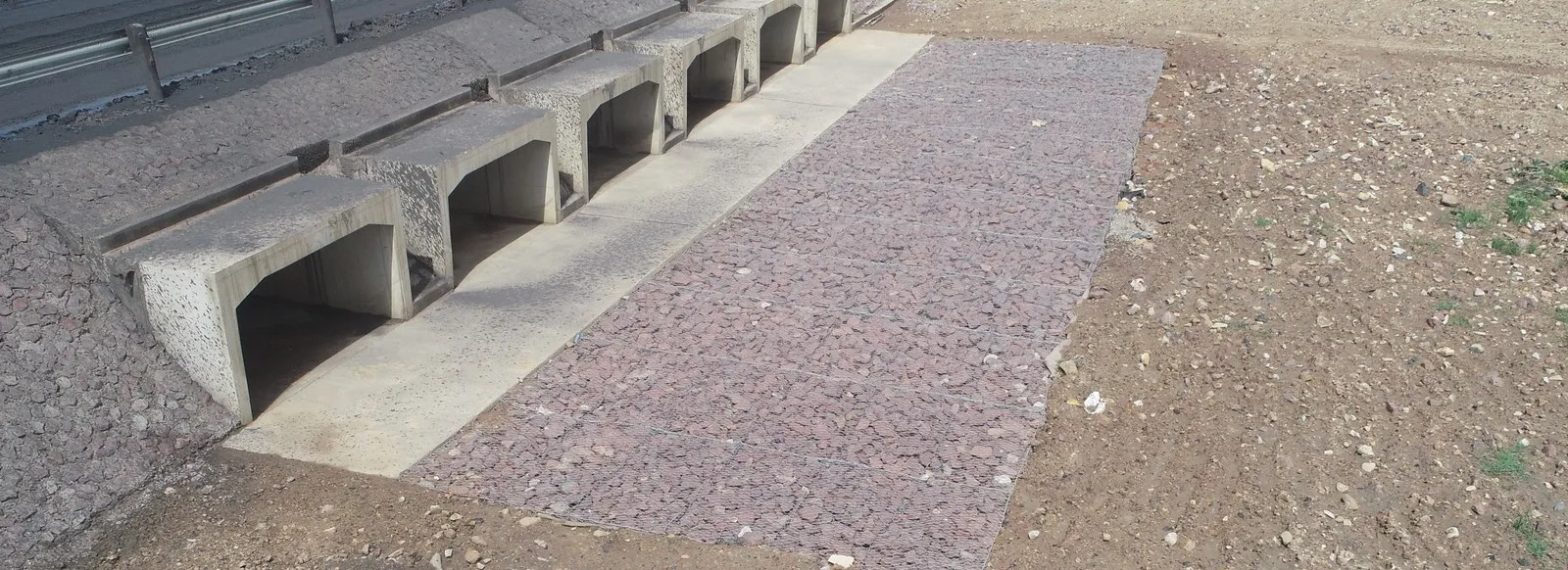
Road and rail crossings decide where water backs up and where it spills, so they are in the model. Where survey data for a structure exists, we use it. Where it does not, our tools estimate the opening sizes and embankment heights from the terrain and road data. Where a structure is critical to the result, we go out and survey it ourselves.
01 · Flood maps
Flood maps for any area of South Africa
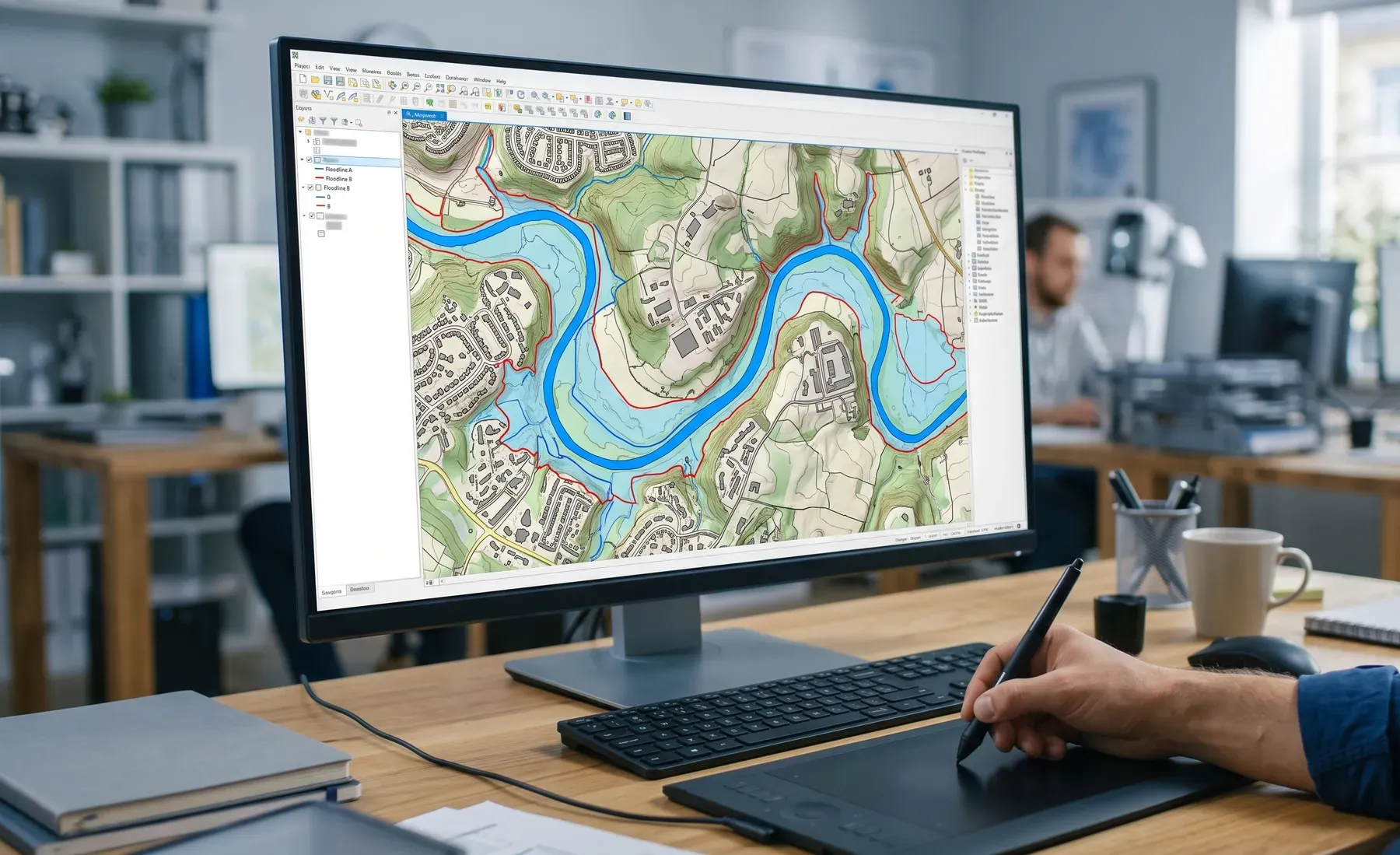
Flood maps for any area of South Africa, produced with the same 2D hydraulic models we use for regulatory floodline studies. They are suitable for underwriting and accumulation control as well as for planning, design and disaster risk management. Each map set is licensed as GIS data, or served through the Delta Hydro platform and API.
- Floodlines at each return period, as vector polygons
- Flood depth rasters
- Flow velocity rasters
- Water surface elevation
- Hazard class, from depth and velocity combined
- Methodology report and reviewer brief with every set
- Climate change scenarios on request
02 · Flood risk assessments
Flood risk assessments for sites and portfolios
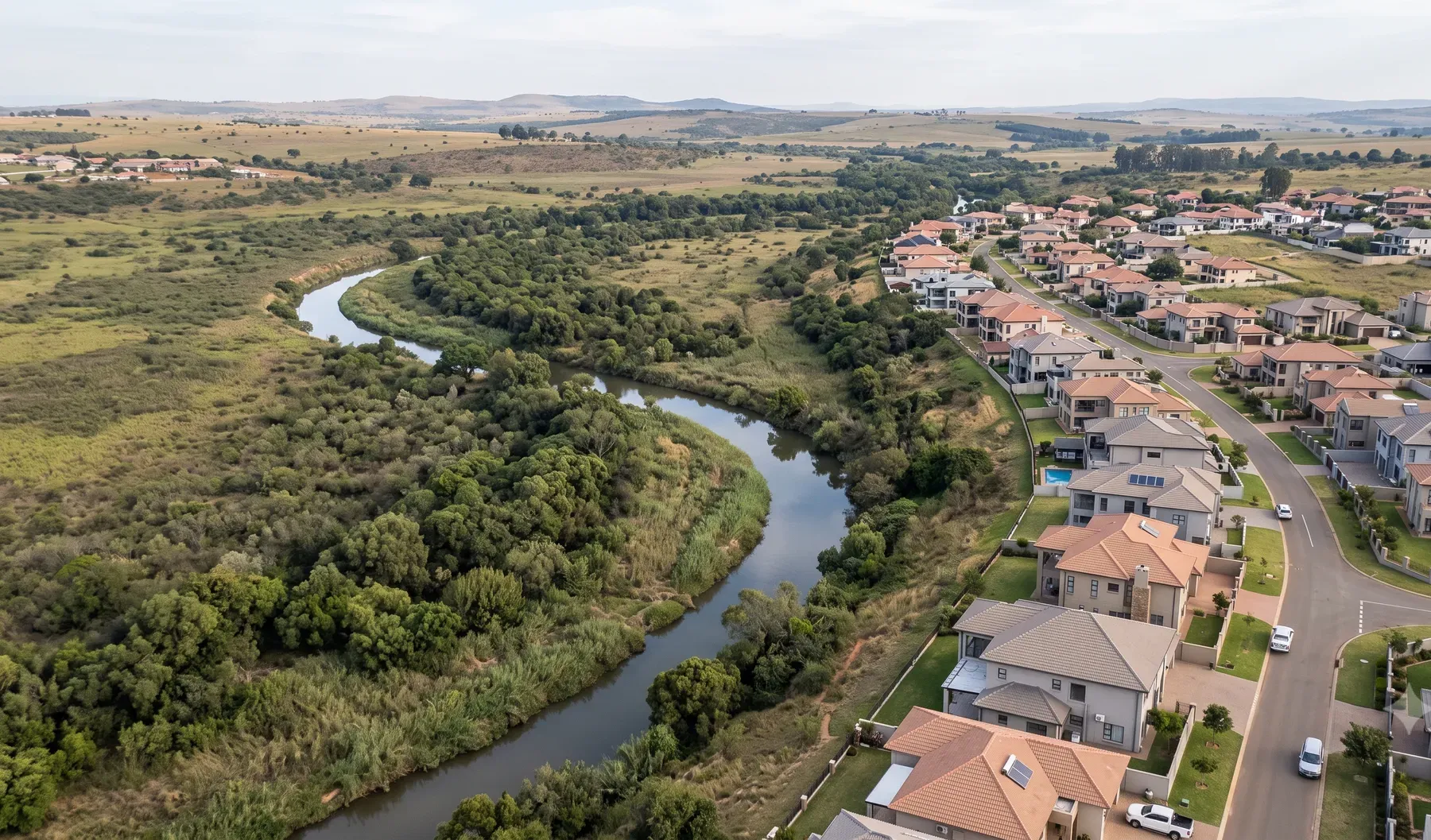
Assessments turn the flood maps into answers for a specific site or portfolio. Each one comes with a report that states the method and its limits, and with the data in a form you can load into your own systems. Climate change sensitivity is included on request.
-
Site assessments
For a single property, site or proposed development: modelled flood depth at the stand and at floor level, hazard class, an estimated loss at each return period and, where asked for, mitigation options. Used for underwriting referrals, lending decisions, due diligence and planning applications.
Property flood risk scoring
-
Portfolio assessments
For a book of policies, a loan portfolio or an asset register: every location scored against the model, with expected annual loss, accumulation along each river and concentration by area. Scores are refreshed as the model is updated.
Portfolio flood exposure
-
Post-event loss modelling
After a major flood: the flood footprint, the properties affected and the likely loss, for claims triage, reserving and reinsurance reporting.
Post-event loss modelling
-
Disputed flood claims
Independent hydraulic evidence for a disputed flood claim: the modelled flood at that address on the date of loss, set out so that adjusters, reinsurers and counsel can check it.
Claims dispute support
Example output for one address, 1:100-year flood
Depth at the property
m
Hazard class
Estimated damage
%
Estimated loss
A residential property in Johannesburg, from the Delta Hydro platform. Address withheld. Loss is calculated from the municipal valuation with generic depth-damage curves until South African claims data is available to fit them.
03 · Consulting
Flood and stormwater engineering consulting
The engineers who build the flood model also carry out the studies behind it. We take on flood and stormwater engineering work for developers, municipalities, roads agencies, mines and utilities, and for insurers and lenders who need a question answered that the data alone cannot.
- Floodline determinations for developments and planning approvals
- Flood risk and mitigation studies for towns, roads and infrastructure
- Stormwater master planning
- Hydraulic design of culverts, bridges and canals
- Dam break assessments
- Dam safety assessments
- Review of third-party flood models and floodlines
- Expert reports for disputed flood claims
How you receive the flood data
-
01
Delta Hydro platform
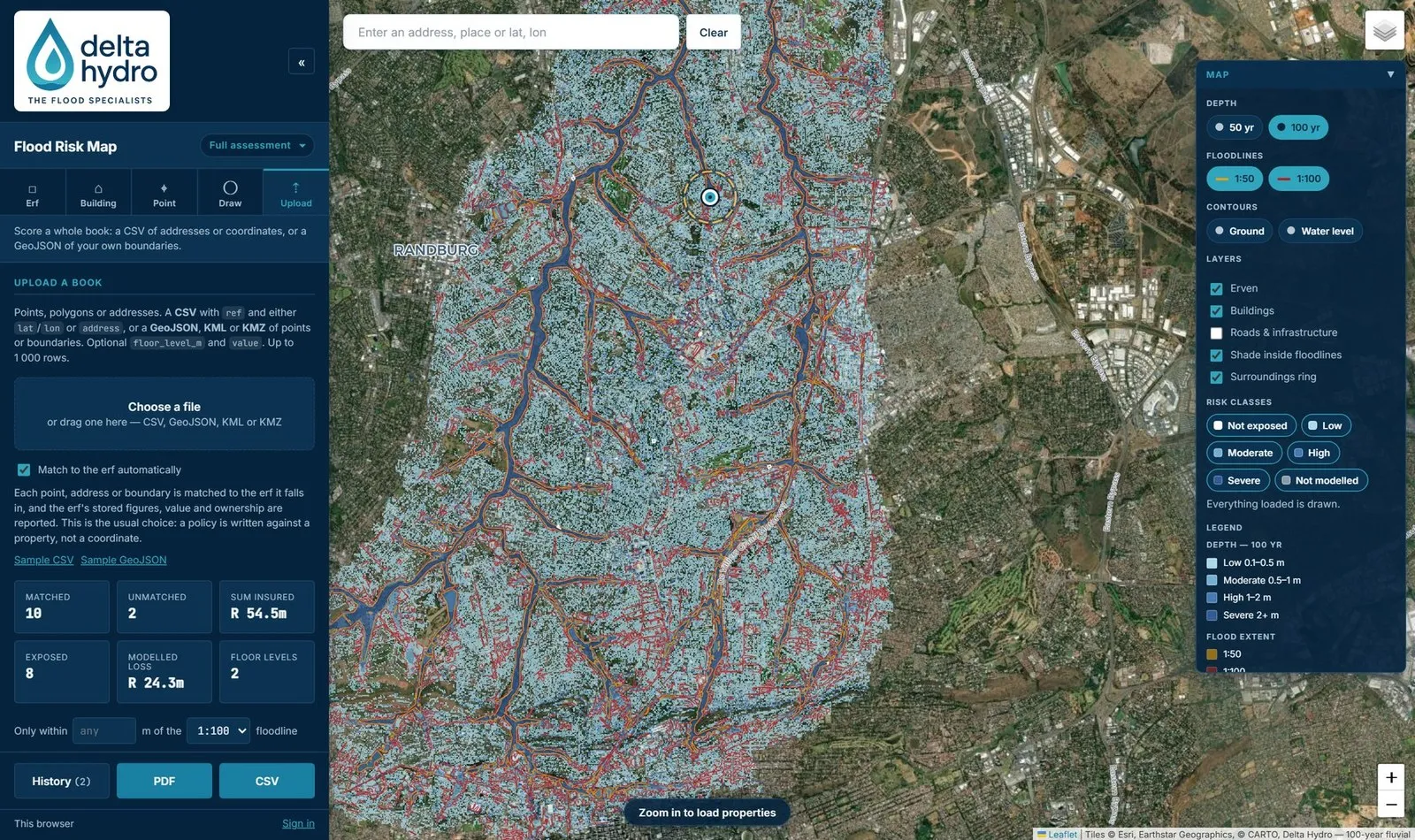
Search an address or upload a list of locations, read the flood depth, hazard class and estimated loss, and download the results. Access is set up for each client.
-
02
API
Flood depth, hazard class and loss estimate for a location, returned to your rating engine, credit system or GIS when the decision is made.
-
03
Data delivery
Flood maps and scores as GeoTIFF, GeoPackage, shapefile or CSV, licensed for use in your own systems. Every value carries its model run and data version.
-
04
Custom integration
We build the connection into your systems: scoring pipelines, scheduled portfolio refreshes and reporting in your own format.
Who uses our flood risk data
-
Insurers
Pricing, underwriting referrals, accumulation control and claims.
-
Reinsurers and brokers
An independent South African view of flood exposure for treaty placement and pricing.
-
Banks and lenders
Flood risk on mortgage and asset-finance books, collateral valuation and climate risk disclosure.
-
Property developers
Floodline determinations, site selection and planning approvals.
-
Municipalities
Flood hazard mapping, stormwater planning and disaster risk management.
-
Roads agencies
Flood exposure of road networks, bridges and culverts, and where to spend first.
-
Asset owners
Utilities, rail, mines and property funds: exposure across every site for insurance renewals, capital planning and disclosure.
-
Consulting engineers
Flood maps and design floods as inputs to drainage, bridge and development design.
Flood risk data in South Africa: common questions
What is flood risk intelligence?
Flood risk intelligence is flood model output turned into answers for a decision: how deep the water gets at a property, how often, what the damage would cost, and where flood exposure builds up across a portfolio. At Delta Hydro it covers flood maps, site and portfolio flood risk assessments, and the engineering advice behind them.
Is there a flood map for the whole of South Africa?
Floodlines exist for many towns, developments and rivers, each produced by its own study. The flood risk data products that cover the whole country are almost all global products, built on satellite terrain at around 30 m with rainfall estimated from global records and no calibration against South African rivers. We cover the whole of South Africa as a service: where a client needs flood data for an area we have not yet modelled, we model it, check it and deliver it.
How is a flood risk map different from a municipal floodline?
A floodline marks the edge of the flood at one return period, usually the 1:50 and 1:100-year, along a defined stretch of river, and it is drawn for planning control. Our flood maps carry depth, velocity, water surface elevation and hazard class at each return period from 1:2 to 1:1 000-year, so a property can be scored rather than only placed inside or outside a line. Where a development application needs a floodline, that is a floodline determination, which we also carry out.
How do I check the flood risk of a property in South Africa?
Start with what the municipality already has on record: several metros publish floodlines in an online map viewer. A published floodline only tells you whether the property is inside the line. A site assessment gives the modelled flood depth at the stand and at floor level, the hazard class and an estimated loss at each return period, with a report that states the method and its limits.
Which flood types, return periods and outputs do you provide?
River and surface water (pluvial) flooding; coastal flooding is in development. Return periods from 1:2 to 1:1 000-year, as required. Outputs are flood extent, depth, velocity, water level and hazard class, as GeoTIFF, GeoPackage, shapefile or CSV, through an API or on the Delta Hydro platform, in Hartebeesthoek94 with Lo or UTM coordinates.
Do your flood models account for climate change?
On request. We model future rainfall scenarios for flood maps, and flood risk assessments can include a climate change sensitivity.
How do you model bridges and culverts?
Road and rail crossings decide where water backs up and where it spills, so they are in the model. Where survey data for a structure exists, we use it. Where it does not, our tools estimate the opening sizes and embankment heights from the terrain and road data. Where a structure is critical to the result, we survey it ourselves.
How are the flood maps checked?
Every map passes a set of automated checks before release: flood depths that increase with return period, volume balance within tolerance, and a stated coordinate system and data version. Each flood depth, score and loss estimate is tagged with the model run, the terrain and rainfall data versions and the date it was produced, and every map set comes with a methodology report and a reviewer brief.
How is the estimated flood loss calculated?
From the modelled flood depth at the property and the property value, using depth-damage curves. On the platform the value is the municipal valuation and the curves are generic; they will be fitted to South African claims data once that data is available.
Can we test the flood data before we commit?
Yes. Ask us for a sample dataset: flood maps and property scores for a sample area, in the formats your team works in.
What does a flood map or flood risk assessment cost?
It depends on the size of the area, the number of bridges and culverts in it, whether we have already modelled it, and the return periods, outputs and delivery route you need. We do not publish fees, because a figure without a scope is easy to misread. Send us the area, site or portfolio and we will send an itemised proposal.
Further reading on flood risk
- What is flood risk intelligence? A guide for South African insurers
- Property-Level Flood Scoring vs Catchment-Scale Hazard Layers: When Does Each Matter?
- Building a National Flood Hazard Map: What Goes Into It
- Quantifying flood exposure across an insurance portfolio
- Reinsurance-Grade Flood Loss Models in South Africa: What That Requires
- Post-Event Loss Modelling: From Flood Footprint to Portfolio Impact
- Defending flood claims with independent hydraulic modelling
- How to Check if a Property Is in a Floodline: Municipal Flood Maps, City by City
- Who Must Assess Flood Risk? The Disaster Management Act and the Climate Change Act
- DEM and LiDAR Accuracy: Why Terrain Data Makes or Breaks a Flood Model
- What Is a 100-Year Flood? Return Periods and AEP Explained
About Delta Hydro
To discuss a flood map, an assessment or a study, contact one of our engineers.
Delta Hydro is a flood engineering consultancy based in Stellenbosch. Our engineers have 27 combined years of flood, hydraulic and hydrological modelling experience in South Africa, the rest of Africa, Europe, Australia and the Middle East, and carry out regulatory floodline studies, stormwater and dam engineering alongside the flood risk data work. The same engineers build and check the models behind the data.
If you would like to evaluate the data first, ask us for a sample dataset: flood maps and property scores for a sample area, in the formats your team works in.
- Stephan Dreyer Director
- Robert Fortuin Director, Pr Eng
- Josh Spooner Civil Engineer