

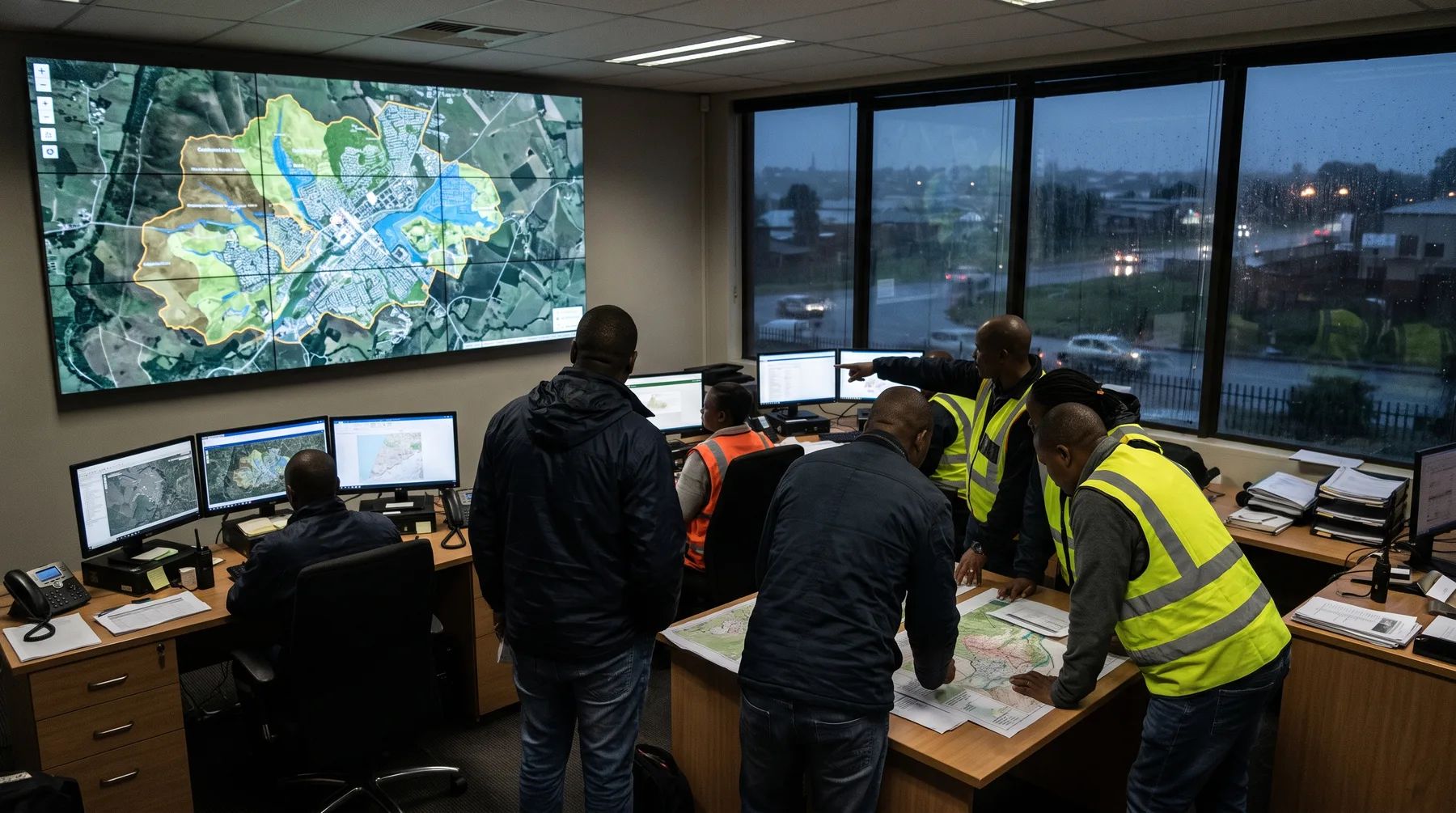
Who Must Assess Flood Risk? The Disaster Management Act and the Climate Change Act
· Written by Stephan Dreyer · Reviewed by Robert Fortuin
Every municipality in South Africa must assess and map its disaster risks, flooding included, and plan for the impacts of climate change. That duty comes from section 53 of the Disaster Management Act, as amended in 2015. The Climate Change Act adds a separate duty for provinces, metros and districts to assess and map climate change risks, but that section has not yet come into force. Neither Act requires a floodline for every river, and neither replaces the site-specific floodline a development needs.
Building a municipal flood risk assessment or a climate risk map? We map flood hazard and exposure across a municipality and turn it into priorities a council can act on.
Flood risk assessmentThe Disaster Management Act: section 53
The Disaster Management Amendment Act (Act 16 of 2015) substituted section 53(1). It now says “each municipality must”:
- “conduct a disaster risk assessment for its municipal area”;
- “identify and map risks, areas, ecosystems, communities and households that are exposed or vulnerable”;
- prepare a disaster management plan that sets out, among other things, the “expected climate change impacts and risks for the municipality”;
- “provide measures and indicate how it will invest in disaster risk reduction and climate change adaptation”;
- “develop early warning mechanisms and procedures for risks identified in the municipal area”;
- consult the local community on the preparation or amendment of its plan.
The 2015 amendment applied matching duties elsewhere:
| Who | Section | Duty |
|---|---|---|
| National organs of state | 25(1) | Disaster risk assessment for their functional area, including climate change impacts |
| Provincial organs of state | 38(1) | Matching duties for their functional area |
| Provinces | 39(1) | Disaster risk assessment for the provincial area |
| Municipal organs of state other than municipalities | 52(1) | The same duties as municipalities |
| Municipalities | 53(1) | As listed above |
The Act’s disaster management centres, national (section 20), provincial (section 33) and municipal (section 47), must, to the extent that they have the capacity, guide organs of state, the private sector, communities and individuals “to assess and prevent or reduce the risk of disasters”.
The Climate Change Act: section 17 is not yet in force
The Climate Change Act (Act 22 of 2024) came into force on 17 March 2025 by Proclamation 251 of 2025, “save for” a list of sections. Section 17 is on that list, along with section 21 (the National Adaptation Strategy and Plan).
When it does commence, section 17 will require “an MEC and a mayor of a metropolitan or district municipality” to:
- undertake a climate change needs and response assessment “within one year of the publication of the National Adaptation Strategy and Plan”;
- in that assessment, “identify and spatially map” the risks, vulnerabilities, areas, ecosystems and communities vulnerable to climate change;
- within two years of the assessment, develop and publish a climate change response implementation plan, which for a metro or district forms part of its integrated development plan;
- review both at least every five years.
Local municipalities are not named in section 17. And the timetable runs from the National Adaptation Strategy and Plan, which section 21 requires “within two years of the coming into operation of this Act”. Section 21 is also excluded from commencement, so the section 17 deadlines cannot start until both sections are in force and the plan is published. The plan must itself consider disaster risk assessments under the Disaster Management Act (section 21(5)(c)).
We found no later proclamation bringing section 17 into force when we checked in October 2026. Confirm the current position before relying on it.
Section 145 of the National Water Act
The National Water Act adds a duty to share information rather than to assess risk. Section 145 requires water management institutions, such as catchment management agencies and water user associations, to make information on floods, dam risks and “levels likely to be reached by floodwaters” available to the public. Our post on section 144 and section 145 covers both sections.
What this means in practice
- For municipalities, a disaster risk assessment that treats flooding properly needs mapped flood hazard across the municipality, not only a list of past events. Floodlines from development applications, flood records and catchment-scale modelling all feed it.
- For insurers and banks, the municipal disaster management plan and risk maps are public records worth reading for any portfolio concentrated in one municipality. They show where the municipality itself expects flooding, and what it plans to do about it.
- For developers, none of these duties replaces the site floodline. A municipal risk map is too coarse to set a floor level or a building line, and municipalities still require a site-specific floodline for township establishment and many other applications.
See our flood risk assessment service, our flood risk intelligence work for portfolios, and our municipalities sector page, or get in touch.
This post explains the documents listed below. It is not legal advice; requirements change and are applied case by case, so confirm them with the relevant authority before relying on them.
Documents referenced
Links go to official government copies wherever one is published online. Check for amendments before relying on a specific clause.
- Disaster Management ActAct · Act 57 of 2002 · Parliament of South Africa
- Disaster Management Amendment ActAct · Act 16 of 2015 · Parliament of South Africa
- Climate Change ActAct · Act 22 of 2024 · Parliament of South Africa
- Commencement of the Climate Change Act, 2024Regulations · Proclamation 251 of 2025 · The Presidency
- National Water ActAct · Act 36 of 1998 · Department of Water and Sanitation
Working on a site where flooding, stormwater, or floodlines are a concern? Send us a message about it and we’ll reply within one business day — no obligation.
Talk to an engineer