

Berms, Levees and Flood Walls Next to Rivers: When Are They Legal?
· Written by Stephan Dreyer · Reviewed by Robert Fortuin
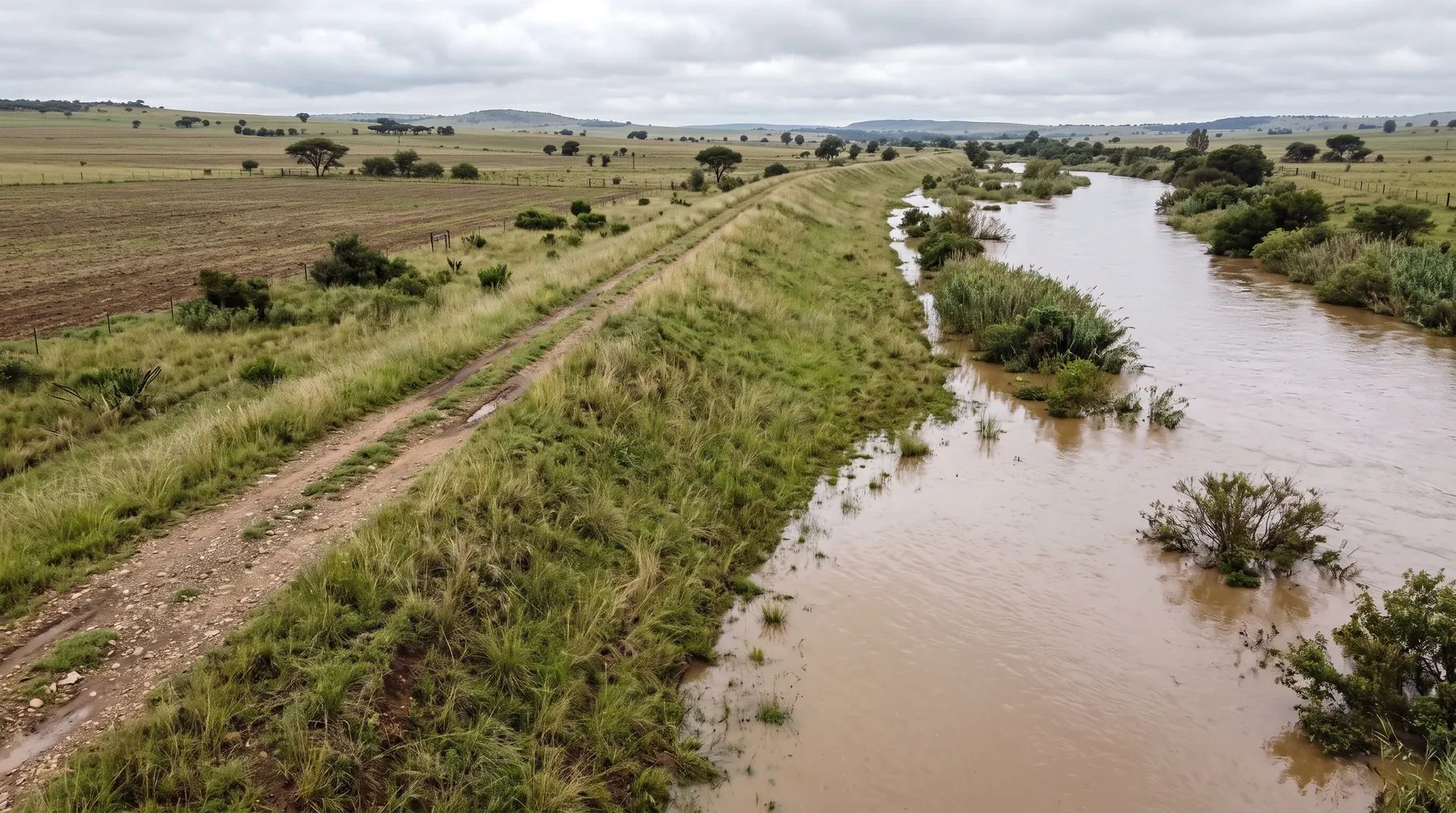
A berm, levee or flood wall built to keep a river off your land is rarely something you can simply build. Inside the regulated area of a watercourse it is a water use that needs authorisation. Cape Town, Johannesburg and eThekwini all require consent or a permit for it, and an engineer has to show it will not push the flood onto someone else. Built without the authorisations that apply, it is unlawful. And if it floods a neighbour, it can make you liable for the damage.
Thinking of a berm or wall to protect a property from a river? We assess whether it works, what it does to flood levels elsewhere, and which approvals it needs, before anything is built.
Flood risk assessmentWhy a berm is a water use
Section 21 of the National Water Act lists “(c) impeding or diverting the flow of water in a watercourse” and “(i) altering the bed, banks, course or characteristics of a watercourse” as water uses. The General Authorisation for these uses (GN 4167 of 2023) defines impeding as “to, in any manner, hinder or obstruct the instream flow of water temporarily or permanently”, and diverting as causing the flow “to be rerouted temporarily or permanently”. The Department of Water and Sanitation is likely to treat a berm on the bank, or across the path a flood would take over the floodplain, as both.
The General Authorisation applies within the regulated area of a watercourse: the 1:100-year floodline or the riparian edge, whichever is further, otherwise 100 m from the watercourse, and 500 m around a wetland. Our post on the lines that control building near a river explains the regulated area.
A berm inside that area can be registered under the General Authorisation only if:
- the DWS risk matrix, completed by a SACNASP-registered professional, rates it Low risk; and
- it does not store water. The notice does not apply “where storage of water results due to the impeding or diverting of flow”.
Otherwise it needs a full water use licence. A berm that would hold water back is likely to need a licence for that reason; confirm with the Department’s regional office or the catchment management agency. The words “berm”, “levee” and “flood protection” do not appear in the notice, and nothing of the kind is on its list of activities that need no risk assessment.
Municipal rules
| Municipality | What applies to berms and walls | Source |
|---|---|---|
| Cape Town | Berms, levees, walls, fences and fill are all “structures”. Below the 50-year floodline, levees are conditionally permitted, subject to a registered engineering professional certifying that they will not “materially increase flood hazards for other property owners or adversely affect flood behavior or the stability of river channels”. The policy bars obstruction to the free flow of water within the 20-year floodline area. Written Council consent is needed for any activity that may raise flood levels | Floodplain and River Corridor Management Policy 2009; Stormwater Management By-law 2005, s5 |
| Johannesburg | A permit from the Johannesburg Roads Agency is needed for an embankment or berm impounding water deeper than 450 mm or holding more than 50 m³, and for any clearing within a floodplain | Stormwater Management By-laws 2010, s5 |
| eThekwini (Durban) | Written consent for any activity that may raise flood levels or damage another person’s premises | Stormwater Management By-law 2020, s5(1) |
Fences need care too. Cape Town’s policy requires fencing below the 50-year floodline to be visually permeable from ground level (palisade, for example), and not to affect the free flow of water or the movement of aquatic fauna.
Environmental authorisation
A berm or wall can also trigger the NEMA EIA regulations. Listing Notice 1 lists structures with a footprint of 100 m² or more within a watercourse, or within 32 m of one where no development setback exists (activity 12), and moving more than 10 m³ of material into or out of a watercourse (activity 19). Activity 12 excludes development in urban areas and within existing road reserves, and temporary structures removed within 6 weeks where no indigenous vegetation is cleared. Outside those exclusions, a long earth berm along a bank can meet both thresholds.
Your neighbours
A berm that keeps water off your land sends it somewhere else: across the river, upstream, or round the end of the berm onto the next property. The Supreme Court of Appeal held in 2018 that a person whose construction work “causes water to flow elsewhere than its normal, natural course or to flow greater, faster or stronger than usual, will be liable if it causes damage” unless they act under a right and take reasonable care. Our post on whether your development will flood your neighbours covers the law and the test.
When a berm is legal, and when it is not
Likely legal when it:
- is outside the regulated area and the floodplain, or is registered under the General Authorisation (Low risk, no storage) or licensed;
- has the municipal consent and building plan approval it needs; and
- has been shown by an engineer not to raise flood levels or velocities on anyone else’s land.
Not legal when it:
- is built in the regulated area without authorisation;
- holds water back without a licence; or
- obstructs flow where the municipality bars it, such as within Cape Town’s 20-year floodline area.
Whatever its approvals, a berm that sends floodwater onto a neighbour can expose you to a claim. Approval is a defence only if the berm was built as approved and with reasonable care.
Why a levee needs engineering
A levee that fails can be worse than no levee: it holds the flood back until it breaches, then releases it suddenly onto land that was thought to be protected. An engineered design checks:
- Overtopping: what happens in a flood bigger than the design flood, and where the levee overtops first.
- Scour and erosion of the river face and the toe. Our posts on why erosion protection fails and gabions vs Reno mattresses vs riprap cover the protection.
- Seepage through and under the embankment during a long flood.
- The water behind it: rain falling on the protected side has to drain out. A levee with no outlet traps local runoff.
- Size: the National Water Act’s dam safety chapter defines a dam as any structure capable of impounding water, “including temporary impoundment”. A levee that could impound more than 50 000 m³ behind a wall higher than 5 m could meet the definition of a dam with a safety risk; check with the Dam Safety Office.
Alternatives that need less approval
Before a berm, consider measures on the building itself: raising floors above the flood level with freeboard, flood-resilient construction, or moving what matters out of the flood zone. Our posts on freeboard and how to reduce flooding on your property legally set out the options.
See our flood risk assessment and water use licence services, or send us the site details.
This post explains the documents listed below. It is not legal advice; requirements change and are applied case by case, so confirm them with the relevant authority before relying on them.
Documents referenced
Links go to official government copies wherever one is published online. Check for amendments before relying on a specific clause.
- National Water ActAct · Act 36 of 1998 · Department of Water and Sanitation
- General Authorisation for water uses under section 21(c) and (i)Regulations · GN 4167 of 2023 · Department of Water and Sanitation
- Floodplain and River Corridor Management PolicyPolicy · City of Cape Town
- Stormwater Management By-law, 2005By-law · City of Cape Town
- Stormwater Management By-laws, 2010By-law · City of Johannesburg
- EIA Regulations Listing Notice 1 (as amended)Regulations · GN 327 of 2017 · Department of Environmental Affairs (gazette copy hosted by KZN EDTEA)
- Pietermaritzburg and District Council for the Care of the Aged v Redlands Development Projects (Pty) Ltd [2018] ZASCA 51Judgment · Supreme Court of Appeal
Working on a site where flooding, stormwater, or floodlines are a concern? Send us a message about it and we’ll reply within one business day — no obligation.
Talk to an engineerRelated services
Who this is for
Related posts
- Between the 1:50 and 1:100-Year Floodlines: What Each Municipality Allows
- Building Near a River in South Africa: Every Law That Applies to Your Site
- How to Check if a Property Is in a Floodline: Municipal Flood Maps, City by City
- Climate Change and Floodlines: Should Your Floodline Allow for Heavier Rain?