

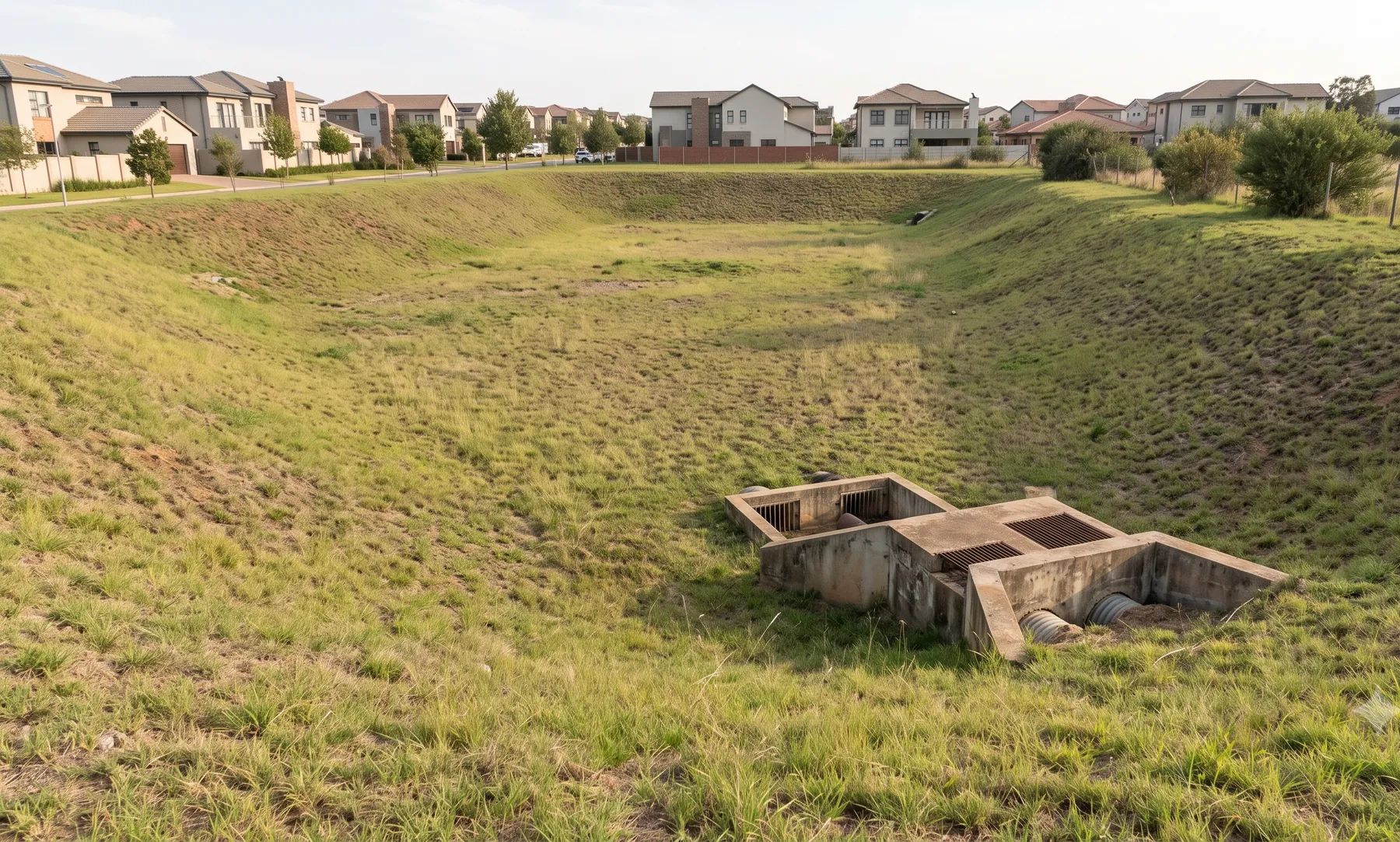
What is detention basin design?
Detention basin design attenuates stormwater peaks using controlled storage and outlet works—protecting downstream systems and meeting municipal stormwater expectations.
Storage that attenuates the right storms
Detention design is often governed by small frequent storms for water quality and large rare storms for freeboard. We document which event controls outlet sizing, how bypasses behave when blocked, and how maintenance keeps orifices functioning.
Municipal policy translation
We translate policy language (such as the City of Cape Town’s Stormwater Management By-law or the equivalent in your municipality) into orifice tables, stage curves, and inspection notes your approving authority can defend in audits.
What we typically need from you
- Catchment imperviousness, time of concentration, and target outflow or detention volume criteria
- Municipal outlet control policies, orifice equations permitted, and freeboard rules
- Geotech infiltration notes, liner requirements, and groundwater proximity
- Architectural grading, lot drainage, and overflow path constraints
Where we add technical depth
- Stage-storage routing with explicit low-flow, primary, and emergency overflow performance
- Erosion and maintenance risk review at inlet, outlet, and embankment toes
- Integration with upstream conveyance and downstream receiving capacity
- Schedules and typical details that civils can drop into drawings
When do you need this?
- Peak flow reduction for downstream constraints
- Water quality pretreatment upstream of sensitive receptors
- Municipal conditions requiring on-site attenuation
Our approach
-
Hydrology inflows
Define critical storm inflows and land-use scenarios.
-
Routing & storage
Apply modified Puls or equivalent routing with outlet controls.
-
Safety & overflows
Design emergency overflow paths and freeboard philosophy.
-
O&M
Document sediment management and inspection schedules.
What you'll receive
- Basin design report
- Stage-storage-outlet tables
- Drawings (scope-dependent)
Relevant SA standards
- Municipal stormwater guidelines (region-specific)
FAQ
Should the basin be vegetated or hard-lined?
It depends on maintenance, water quality goals and site constraints, including infiltration, liner requirements and groundwater proximity from the geotechnical notes. A grassed basin that is dry between storms can sometimes double as open space; either way we review erosion risk at the inlet, outlet and embankment toes.
Can you model basins in series?
Yes. Cascaded basins are routed as a network, so each basin's outflow is the next one's inflow, and the system is checked against upstream conveyance and downstream receiving capacity.
How is sediment handled?
We specify forebays, clean-out frequencies, and access for maintenance equipment.
How do you set freeboard?
Freeboard follows the municipality's freeboard rules and the consequence of overtopping at the site, checked against the large rare storms. An emergency overflow path carries events beyond the design storm safely, away from private yards and buildings.
Author
Stephan DreyerAreas we serve
We work on projects across South Africa — see locations.
Related services
Related reading
- Detention vs Retention: Choosing the Right Stormwater Attenuation for Your Site
- Energy Dissipators: Slowing Water Down Before It Destroys Your Channel
- SANS 10400-R: What Your Building Plan Must Show About Stormwater
- Stormwater Attenuation Requirements in South African Metros Compared
- Stormwater Management Plans: SA Municipal Requirements Explained
Ready to get started?
Contact us