

Stormwater Attenuation Requirements in South African Metros Compared
· Written by Stephan Dreyer · Reviewed by Robert Fortuin
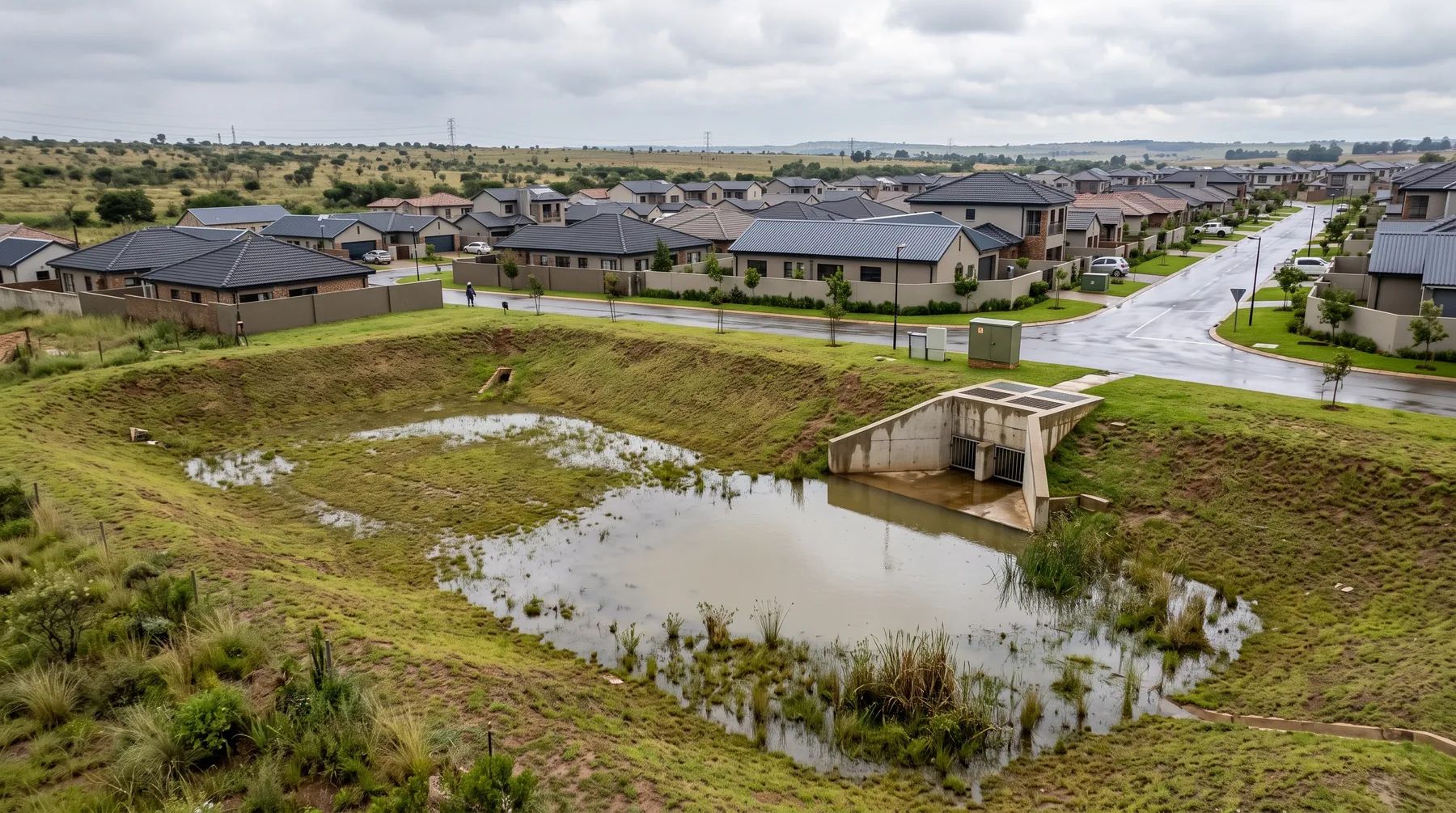
Many South African municipalities require that the peak stormwater leaving a developed site does not exceed the peak that left it before development. That is the attenuation requirement. What differs from one municipality to the next is which storms it applies to, from what site size, and what “before development” means. This post compares the published rules.
Need to show your site meets the municipality's attenuation rule? We size the detention for the storms your municipality specifies and prepare the stormwater management plan.
Detention basin designThe rules, municipality by municipality
| Municipality | Storms to attenuate | When it applies | Source |
|---|---|---|---|
| Johannesburg | Post-development peak for the 5- to 25-year storms, of any duration from 0.25 to 24 hours, may not exceed the pre-development peak; up to the 50-year storm if the JRA stipulates it. The pond must withstand the 1:50-year storm | ”All developments on land exceeding 8 500 m2 are subject to stormwater attenuation on site” (JRA Code of Procedure) | Stormwater Management By-laws 2010, s38; JRA Code of Procedure (2015), ch 8 |
| Cape Town | Peaks up to the 10-year storm reduced to pre-development level, up to the 50-year to existing development levels, plus 24-hour extended detention of the 1-year storm | On-site treatment and attenuation for greenfield, brownfield and existing sites over 4 000 m². Smaller sites with more than 600 m² impervious: not required where regional measures exist; otherwise treatment of the ½-year, 24-hour storm and attenuation up to the 1:50-year | Management of Urban Stormwater Impacts Policy 2009; Standards and Guidelines for Roads and Stormwater v3.0 (2022), s10.5.1.2 |
| eThekwini (Durban) | Facilities designed to control the 1:10, 1:50 and 1:100-year floods, back to undisturbed natural conditions | Subdivisions and new developments (subdivisional approval criteria) | Coastal, Stormwater and Catchment Management department |
| Mangaung (Bloemfontein) | Post-development flows preferably not to exceed pre-development flows for the 1:5 and 1:25-year events | Per the draft land use scheme amendment (2025) | Draft Land Use Scheme amendment, cl 47(8)(p) |
| George | Downstream peak “no greater than it was before the development”; new development must incorporate flood attenuation measures | No return period or size threshold stated | Stormwater By-law 2023, s26 |
| Stellenbosch | Flood attenuation measures defined as keeping the downstream peak no greater than before the development | No return period stated | Stormwater By-law 2021, s1 |
| Msunduzi (Pietermaritzburg) | Attenuation required “for any property that is not a single homestead” | Draft by-law (2024) | Draft Stormwater Management By-law, s8(4) |
| Tshwane | The City may require a service scheme report including on-site attenuation | Case by case | Land Use Scheme 2024, cl 18(10)(e)(i) |
We found no published attenuation criteria for Ekurhuleni, Polokwane or Mbombela. There, expect the criteria to be set in conditions of approval; ask the municipality’s stormwater engineer before sizing anything.
What “pre-development” means
This is where the rules differ most, and where brownfield sites get caught out:
- eThekwini measures against “undisturbed natural conditions”: the site as veld or bush, even if it is already built on. Redeveloping a paved site can therefore still require attenuation.
- Cape Town’s policy defines pre-development as “prior to any development on that property”. Peaks up to the 10-year storm must come back to that level; peaks up to the 50-year storm only to existing development levels.
- Johannesburg compares post-development with the pre-development peak for the specified storms.
State the baseline in the stormwater report, and agree it with the municipality early. On a site that is already paved, it can decide whether you need a pond at all.
Planning figures and design
For early planning in Johannesburg, the JRA Code of Procedure says “a volume of 350 m3/ha of storage is required. This applies to a pond subjected to a 1 in 50 year storm event.” That figure is for planning only; the design has to show the actual pre- and post-development peaks for each specified storm, with flood routing through the pond.
The choice between detention (store and release) and retention (store and infiltrate or reuse) is covered in our post on detention vs retention. What a full stormwater management plan contains is covered in stormwater management plans: municipal requirements.
Attenuation is not flood protection from the river
Attenuation controls what your site sends downstream. It does not lower the floodline of a river draining a large catchment past your site; a pond on 2 ha cannot hold back a river’s 1:100-year flood. Johannesburg’s by-laws make the point directly: no attenuation pond may be placed in a floodplain below the 50-year floodline.
If your site is near a river, the floodline and the attenuation are two separate requirements. Our post on pre- vs post-development floodlines explains how the two are often confused.
Who maintains the pond
An attenuation pond only works if it is kept clear. Cape Town’s Stormwater Management By-law makes owners maintain private stormwater systems at their own cost. Its stormwater policy expects private facilities to be maintained by the owner or body corporate, under an agreement concluded before any property is transferred. Build the maintenance plan into the stormwater management plan, not after handover.
See our detention basin design and stormwater management plan services, or send us the site details.
This post explains the documents listed below. Requirements change and are applied case by case, so confirm them with the relevant authority before relying on them.
Documents referenced
Links go to official government copies wherever one is published online. Check for amendments before relying on a specific clause.
- Stormwater Management By-laws, 2010By-law · City of Johannesburg
- Roads & Stormwater Manual, Vol 1: Code of ProcedureGuideline · Johannesburg Roads Agency
- Management of Urban Stormwater Impacts PolicyPolicy · City of Cape Town
- Standards and Guidelines for Roads and Stormwater, Version 3.0 (February 2022)Standard · City of Cape Town
- Coastal, Stormwater and Catchment ManagementPolicy · eThekwini Municipality
- Land Use Scheme as amended, February 2025 (draft)By-law · Mangaung Metropolitan Municipality
- By-law relating to Stormwater, 2023By-law · George Municipality
- Stormwater By-law, 2021By-law · Stellenbosch Municipality
- Draft Stormwater Management By-law (2024)By-law · Msunduzi Municipality
- Tshwane Land Use Scheme 2024 (listing page)By-law · City of Tshwane
Working on a site where flooding, stormwater, or floodlines are a concern? Send us a message about it and we’ll reply within one business day — no obligation.
Talk to an engineer