

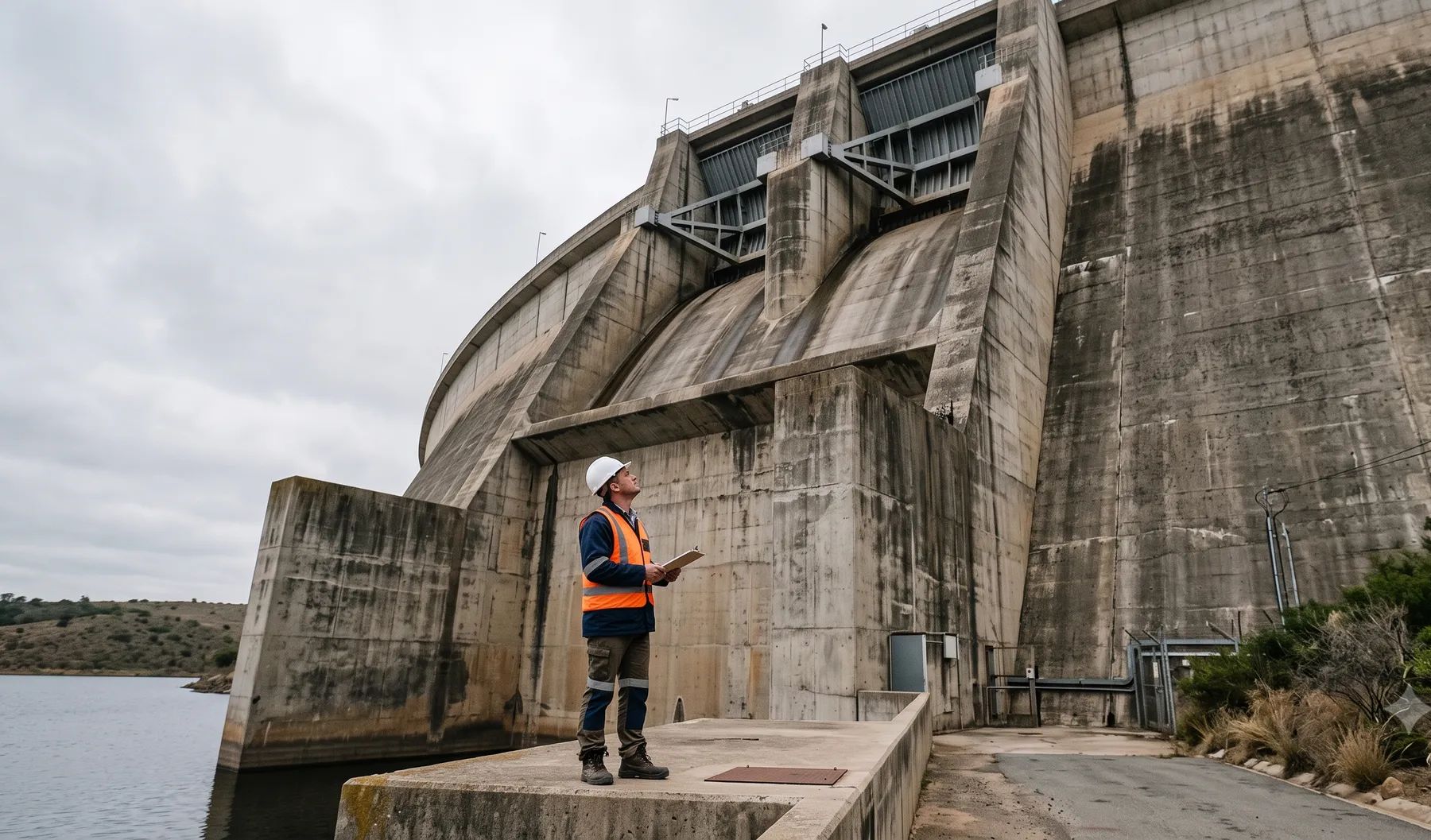
What is dam break analysis?
Dam break analysis estimates downstream inundation and timing for hypothetical breach scenarios—supporting dam safety cases and emergency planning.
Consequence mapping with clear scenario ethics
Dam break studies sit at the intersection of safety, politics, and emergency planning. We document scenario choices conservatively where the brief requires, consistent with SANCOLD dam safety expectations, show sensitivity to breach parameters, and separate planning maps from operational trigger discussions where helpful.
GIS the disaster manager can use
We deliver depth, velocity, and timing products in formats emergency managers can stack with population and infrastructure layers—without hiding model limitations.
What we typically need from you
- Dam geometry, reservoir volume curves, and breach parameter assumptions or guidelines to follow
- Downstream DEM/topo, structures, and land use for consequence mapping
- Prior dam break studies, panel comments, or integrated disaster management formats
- Inflow design floods and routing assumptions feeding the breach scenario
Where we add technical depth
- Scenario definition with documented breach progression and sensitivity cases
- 2D routing where timing, wave attenuation, and valley storage materially change results
- Maps and arrival-time products formatted for emergency planning and GIS ingestion
- Report narrative linking hydrology, breach, and consequence metrics, with breach assumptions and sensitivities documented
When do you need this?
- Dam safety cases requiring downstream inundation mapping
- Emergency preparedness and consequence classification inputs
- Sensitivity testing for breach parameters
Our approach
-
Scenario definition
Agree breach hypotheses and sensitivity matrix with the dam safety team.
-
Routing
Route flood waves with credible 2D/1D approaches depending on terrain.
-
Mapping & reporting
Deliver maps, arrival times, and depths for emergency planning.
What you'll receive
- Dam break modelling report
- Inundation maps and summary tables
Relevant SA standards
- SANCOLD / dam safety expectations
FAQ
Who sets breach parameters?
The breach hypotheses and sensitivity matrix are agreed with the dam safety team before modelling, following any guideline or prior panel comments you provide. We document the breach progression and run sensitivity cases on the parameters.
Can outputs feed emergency services?
Yes. Depth, velocity and timing products are delivered in GIS formats that emergency managers can stack with population and infrastructure layers, or in the integrated disaster management format you supply. Model limitations are stated with the maps.
Do you route the breach in 1D or 2D?
Terrain complexity and map scale decide. We use 2D routing where timing, wave attenuation and valley storage materially change the results, and the report justifies the routing method selected.
Do you include arrival times?
Where required, yes. Arrival times are given as timing bands alongside depths, in maps and summary tables formatted for emergency planning and GIS.
Do you support independent or panel review?
Yes. We respond to reviewer queries with appendices covering the breach scenarios, routing method and sensitivity cases, and can take prior panel comments into account from the start.
Author
Stephan DreyerAreas we serve
We work on projects across South Africa — see locations.
Related services
Related reading
Ready to get started?
Contact us