

Detention vs Retention: Choosing the Right Stormwater Attenuation for Your Site
· Written by Stephan Dreyer · Reviewed by Robert Fortuin
The terms “detention” and “retention” get used interchangeably on site, but they describe two different jobs — and picking the wrong one leads to either a pond that never empties or one that empties too fast to do anything useful. When you develop a site, you harden surfaces, and hardened surfaces shed water faster and in greater volume. Attenuation is how you stop that increase from flooding your neighbours downstream. Which type you need depends on what problem you are actually solving.
Need to prove post-development runoff will not exceed pre-development peaks? We size the attenuation to the requirement your municipality will actually check.
Detention basin designDetention: slow the water down, then let it go
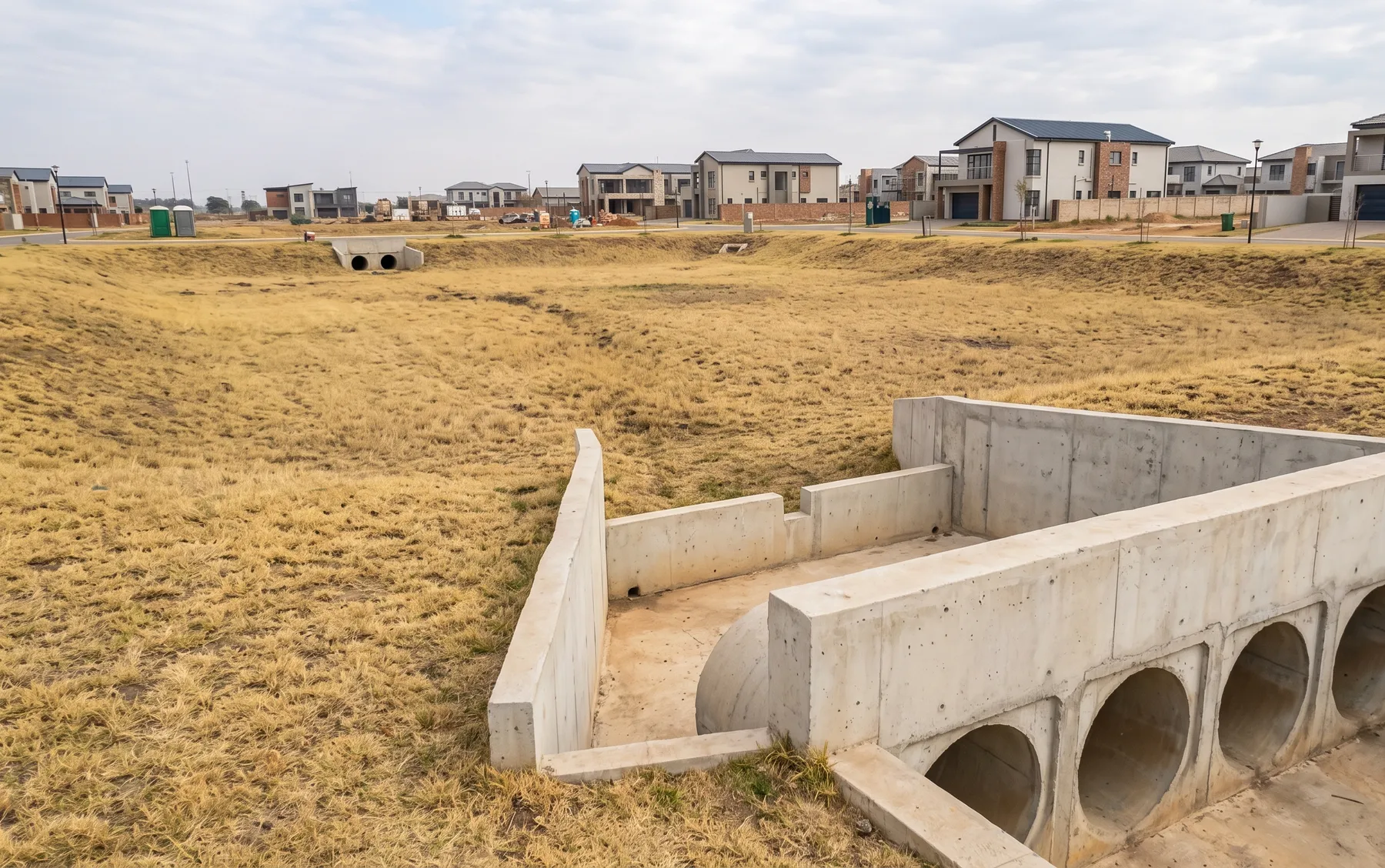
A detention facility temporarily stores runoff and releases it at a controlled rate through an outlet structure. It is normally dry between storms — a grassed basin with an outlet that meters the flow out. The volume that goes in eventually comes out; detention manages the rate, not the total quantity.
This is the workhorse of development stormwater. The near-universal municipal requirement is that post-development peak runoff must not exceed the pre-development peak for the relevant design events. A detention basin sized to hold the difference and bleed it out slowly is how most sites meet that requirement.
Retention: hold the water and keep it
A retention facility stores runoff and removes it by infiltration, evaporation, or reuse rather than by discharging it downstream. A retention pond typically holds a permanent pool of water. Here the goal is to reduce the volume leaving the site — because the receiving system cannot take the extra flow at all, because you want the water-quality benefit of a permanent pool, or because you intend to harvest and reuse the water.
Retention is more demanding of the site: it needs suitable soils for infiltration, or a genuine reuse demand, and it carries a permanent-water maintenance and safety burden that a dry detention basin does not.
The distinction that actually drives the decision
The clean way to hold the two apart:
- Detention controls the rate of discharge. Same volume out, spread over more time. Usually dry.
- Retention controls the volume of discharge. Less water leaves the site at all. Usually holds a permanent pool.
Most South African development approvals are framed around the rate-control requirement, which is why detention is the default answer for the majority of sites. Retention enters the picture when volume reduction, water quality, or reuse is a real objective — or when the downstream system simply has no spare capacity.
What the choice costs you on the layout
Neither is free, and both compete with your developable area:
- A detention basin needs a footprint sized to the stored volume, a properly designed outlet control structure, an emergency spillway for events beyond the design storm, and safe embankments. It is dry most of the time, so the land can sometimes double as open space.
- A retention pond needs all of that plus the permanent pool — which raises safety, liability, water-quality, and long-term maintenance considerations, and generally consumes more area for the same catchment.
Get the outlet and spillway design wrong and the facility either does not attenuate as claimed or fails unsafely in a large event — which is why the outlet structure, not the hole in the ground, is where the engineering sits.
Getting it right for your site
The right choice falls out of three questions: What does the municipality require — rate control, volume control, or both? What will the downstream system actually accept? And what do the site’s soils and levels allow? Answer those before the layout is fixed, because the attenuation footprint is not something you want to discover you need after the erven are drawn — the same sequencing point we make about detention basin design generally.
This decision usually sits inside a broader stormwater management plan that ties the attenuation to the site’s drainage design and the downstream receiving system. Get in touch if you want help sizing the right facility for your development.
Working on a site where flooding, stormwater, or floodlines are a concern? Send us a message about it and we’ll reply within one business day — no obligation.
Talk to an engineer