

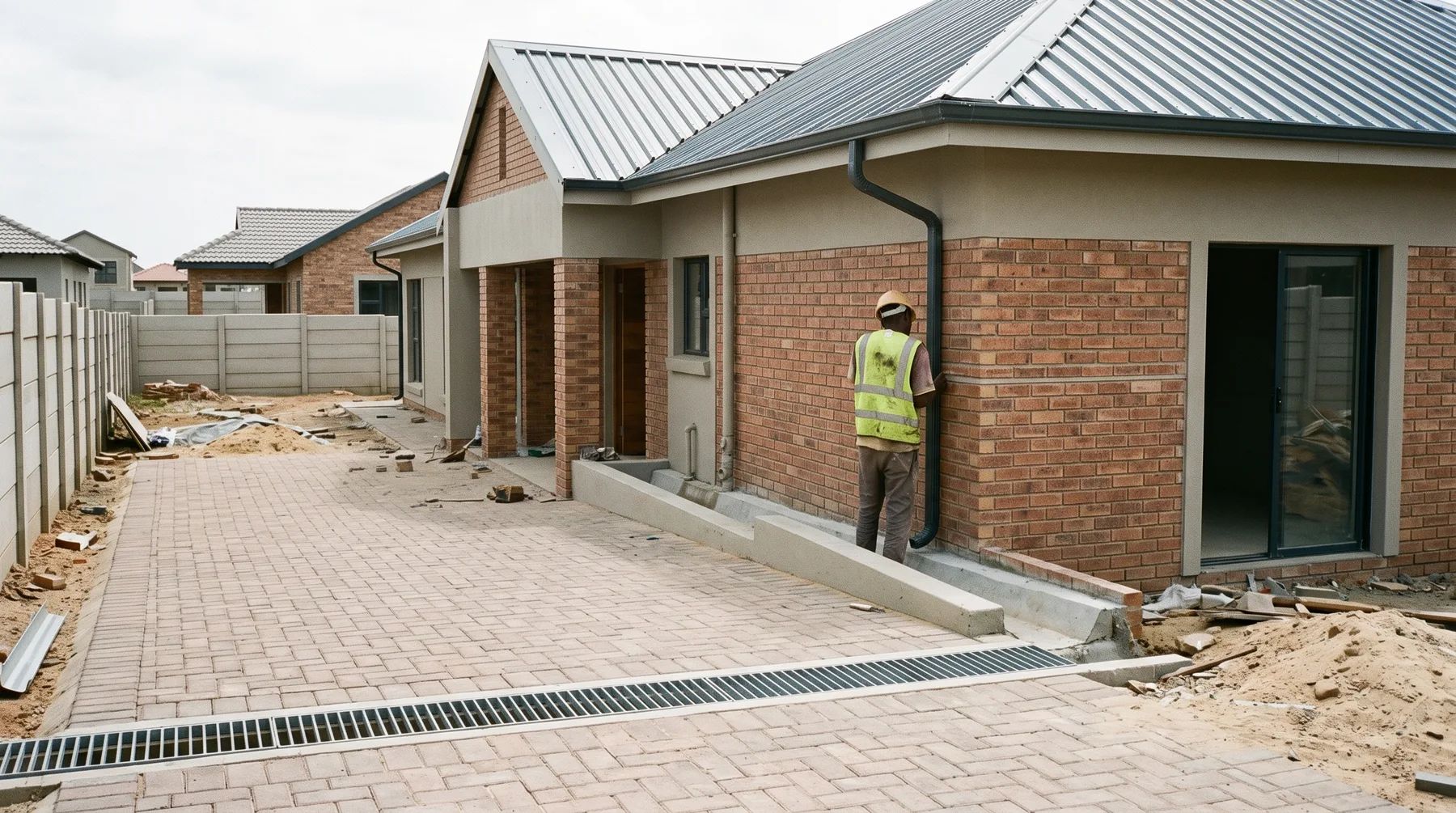
SANS 10400-R: What Your Building Plan Must Show About Stormwater
· Written by Robert Fortuin · Reviewed by Stephan Dreyer
Part R of the National Building Regulations requires the owner of a site to provide “suitable means for the control and disposal of accumulated stormwater” running off earthworks, buildings and paving, and the building plan has to show how. You comply either by following SANS 10400-R, the deemed-to-satisfy standard, or by a rational design from a competent person, which the council can insist on where the site makes it essential. A site used only for a dwelling house is exempt unless its stormwater could cause significant damage. Municipal by-laws then add their own requirements on top.
Council asking for a stormwater design on your building plan? We prepare rational stormwater designs and site drainage layouts that building control can approve.
Drainage designWhat regulation R1 requires
Regulation R1 of the National Building Regulations (GN R2378 of 1990, as amended) has three parts:
- The requirement. The owner of any site must provide suitable means “for the control and disposal of accumulated stormwater which may run off from any earthworks, building or paving”.
- Combined drainage. Those means may be in addition to, or combined with, any drainage works required under regulation F4(2).
- How you comply. The requirement is “deemed to be satisfied” where stormwater disposal follows SANS 10400-R. But where site conditions “render it essential for stormwater disposal to be the subject of an acceptable rational design prepared by an approved competent person”, the council can require one. It must tell the owner its reasons, and it can ask for plans of the complete stormwater installation.
What SANS 10400-R covers
SANS 10400-R:2012 (edition 3, reaffirmed in 2022) is the deemed-to-satisfy standard for Part R. It is a paid SABS standard. Municipal building control forms quote its general requirements, for example clause 4.2.1 as reproduced on Drakenstein Municipality’s stormwater acknowledgement form:
- stormwater from the roof, paving or the area around a building “shall not cause damage”;
- it must “not result in the undercutting of foundations due to erosion or flooding”;
- stormwater must “drain away from buildings, as far as possible, under the action of gravity”;
- the design must “make provision for the drainage of sites that are waterlogged or seasonally waterlogged”.
The deemed-to-satisfy rules aim to get water away from buildings without causing damage. On larger or more complex sites, the design storms, the overland flood route and any attenuation are usually settled through a rational design and the municipality’s own rules.
Most houses are exempt, with one exception
Regulation R2(2) says Part R “shall not apply to any site used exclusively for the erection of any dwelling house or any building appurtenant thereto”. The exception: “where, due to special site features, the discharge of stormwater from such site may cause significant damage, the local authority may require compliance”.
In our experience, special site features include a steep erf draining onto a neighbour, a site below a road or another property that sends water onto it, a site on the edge of a watercourse or floodline, and dolomite or other ground that is damaged by concentrated water. Regulation R2(1) adds that gutters and downpipes are not required where other suitable means are provided.
Deemed-to-satisfy or rational design
The regulations give two routes to compliance (regulation AZ4):
- Deemed-to-satisfy: follow the relevant part of SANS 10400, here SANS 10400-R.
- Rational design or rational assessment: a competent person, registered under the Architectural Professions Act, the Engineering Profession Act, the Natural Scientific Professions Act or another relevant Act, shows that the solution performs at least as well.
Where a rational design is used, regulation A19 requires the owner to “appoint and retain” an approved competent person, who takes responsibility for “that particular system in its entirety”. The council can refuse to accept an appointee on grounds such as not being professionally registered or, for someone who is not the owner’s employee, having no professional indemnity cover; the refusal can be appealed to the Review Board. A person who meets a competent person definition in a part of SANS 10400 is deemed acceptable. The appointment is recorded on Form 2 in SANS 10400-A.
A rational design is the better route whenever the site takes water from upstream, the paved area is large, the discharge point is limited, or the municipality’s by-law asks for attenuation. It shows the reviewer the catchments, the design storm, the flows and where the water goes in a storm bigger than the pipes can carry.
Municipal rules on top of Part R
Part R is the national minimum. Municipal stormwater by-laws and policies usually go further, especially on larger sites:
- attenuation to pre-development peak flows, with triggers and design storms that differ by metro (see stormwater attenuation requirements by metro);
- a stormwater management plan for subdivisions and larger developments (see stormwater management plans);
- conditions on flood-prone sites, such as floor levels above the floodline, which the council can impose under section 10 of the Building Standards Act (see SANS 10400-H and flood risk).
Timelines
Under section 7 of the Building Standards Act, the council must decide a plan application within 30 days where the building’s architectural area is less than 500 m², and within 60 days where it is 500 m² or larger. An approval lapses if building work has not started within 12 months, unless the council extends the period on a written request. Settle the stormwater design before you submit, so that a request for more information does not hold up the decision.
See our drainage design and stormwater management plan services, or send us the site plan.
This post explains the documents listed below. It is not legal advice; requirements change and are applied case by case, so confirm them with the relevant authority before relying on them.
Documents referenced
Links go to official government copies wherever one is published online. Check for amendments before relying on a specific clause.
- National Building Regulations and Building Standards ActAct · Act 103 of 1977 · Parliament of South Africa
- National Building Regulations, Part R: Stormwater disposal (regulation R1)Regulations · GN R2378 of 1990, as amended · Department of Trade, Industry and Competition (consolidated text on Acts Online)
- National Building Regulations, regulation R2: SavingRegulations · GN R2378 of 1990, as amended · Department of Trade, Industry and Competition (consolidated text on Acts Online)
- National Building Regulations, regulation A19: Appointment of persons responsible for designRegulations · GN R2378 of 1990, as amended · Department of Trade, Industry and Competition (consolidated text on Acts Online)
- SANS 10400-R:2012, The application of the National Building Regulations Part R: Stormwater disposalStandard · Edition 3, reaffirmed 2022 · South African Bureau of Standards
- Stormwater discharge acknowledgement form (quotes SANS 10400-R clause 4.2)Guideline · Drakenstein Municipality
Working on a site where flooding, stormwater, or floodlines are a concern? Send us a message about it and we’ll reply within one business day — no obligation.
Talk to an engineer