

Will My Development Flood My Neighbours? The Law and the Test
· Written by Stephan Dreyer · Reviewed by Robert Fortuin
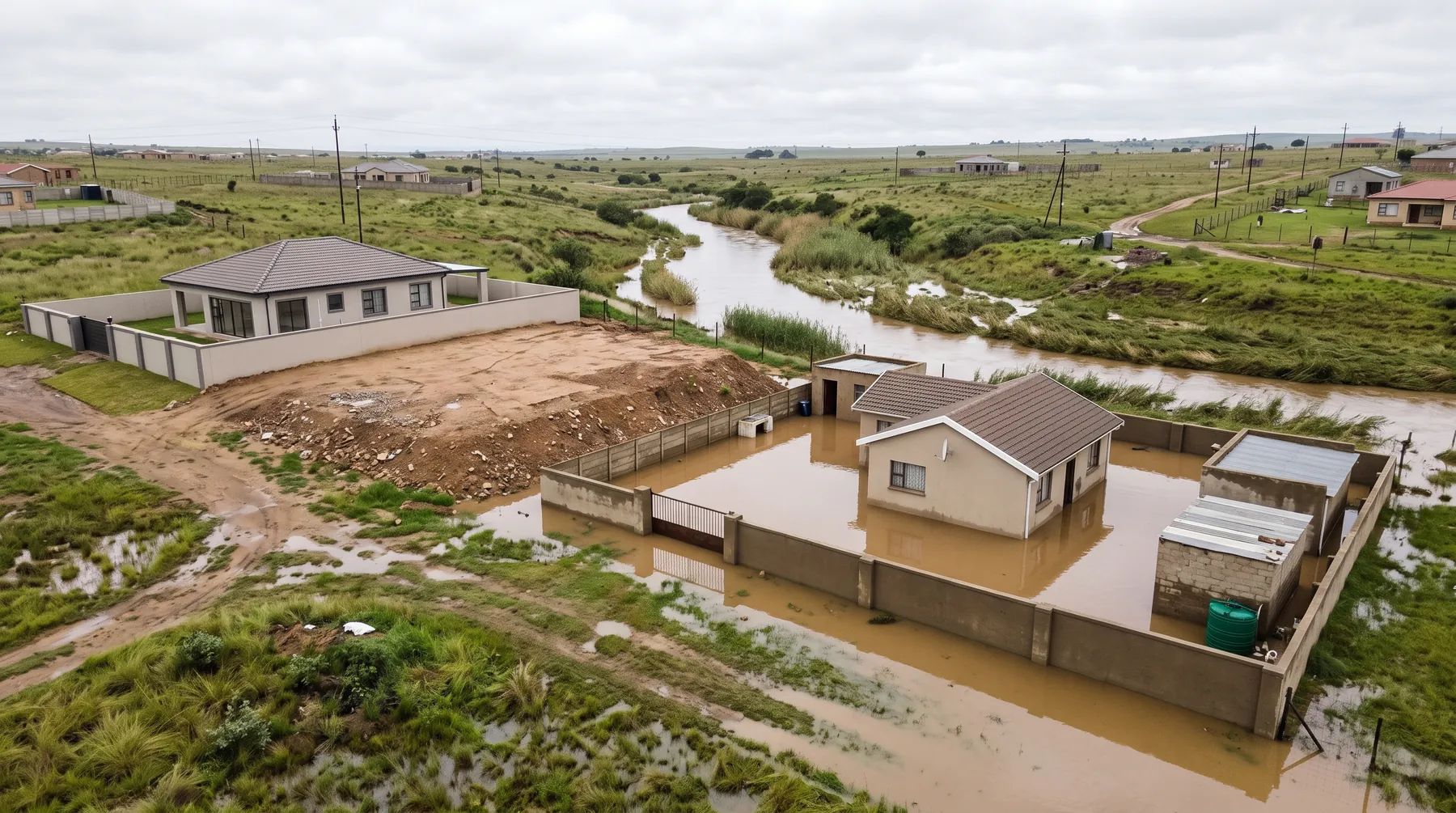
South African law expects a lower-lying property to accept the water that naturally flows onto it from higher land. It does not expect it to accept water that a development has concentrated, diverted or increased. The Supreme Court of Appeal has held that anyone whose works make water flow elsewhere, or “greater, faster or stronger than usual”, is liable for the damage unless they act under a right and take reasonable care. Municipal by-laws add their own consent requirements on top.
Need to show your development will not push water onto your neighbours? We model the site before and after, and report the change at every boundary in a form the municipality can check.
Flood risk assessmentWhat the courts say
Pappalardo v Hau (2009). A lower owner built a boundary wall about 2 m high; the upper owner said it was acting as a dam to rainwater on his property. The Supreme Court of Appeal upheld the lower owner’s appeal. The court summarised the rule that the lower owner is only obliged to accept the “natural flow”: the flow across the boundary that would have occurred before the erven were developed. It also held that “the upper owner has no ‘natural right’, merely as upper owner, to concentrate the flow of water at a particular point”. Concentrated flow can be imposed only under a servitude. The court also cited with approval the rule that, in town, an upper owner should drain to the street where reasonable measures allow.
PADCA v Redlands Development Projects (2018). The court set out three principles (paragraph 18):
“(a) a higher property has a natural servitude over a lower property, which, as the servient property, is obliged to receive the natural water flow from the higher property”
“(b) a higher property has no right to concentrate or divert the flow of water onto a lower property unless it is allowed to do so by a servitude granted by regulation, the nature of the site or established custom”
“(c) a person who undertakes construction work that causes water to flow elsewhere than its normal, natural course or to flow greater, faster or stronger than usual, will be liable if it causes damage unless (a) it acts under a statutory or a common law right and (b) takes reasonable care to ensure that no injury is caused to others.”
In that case, building to municipally approved plans with reasonable care was decisive: the developer’s discharge into the municipal stormwater system was lawful. The court noted that the municipality is the authority “responsible and accountable publicly for assessing and managing the water disposal needs of the area”. A concurring judgment doubted whether the old Roman-law remedy applies to urban properties at all; there, the general reasonableness test of neighbour law may apply instead. Either way, an approved, properly designed stormwater plan is the developer’s best protection.
What municipal rules say
| Municipality | Rule | Source |
|---|---|---|
| Tshwane | ”The Owner is bound and obliged to receive storm water that naturally drains onto the Erf from Land lying on a higher level”, but “The Owner of a higher lying Erf may not concentrate the flow of storm water on a lower lying Erf”. Where concentrated discharge cannot be prevented, and the water cannot be drained directly to a street, the lower owner must accept its passage, and the higher owner pays for any pipe or drain the lower owner needs to carry it | Land Use Scheme 2024, cl 18(1)(a)(ii)(aa) to (dd) |
| Cape Town | Written consent is needed to “undertake any activity which, alone or in combination with other existing or future activities, may cause an increase in flood levels or create a potential flood risk”; for most development in the floodplain, a registered engineering professional must certify that the work “will not materially increase flood hazards for other property owners” | Stormwater Management By-law 2005, s5; Floodplain and River Corridor Management Policy 2009 |
| eThekwini (Durban) | Written consent is needed for any activity that “may cause an increase in flood levels or create a potential flood risk”, or that “may cause damage to another person’s premises” | Stormwater Management By-law 2020, s5(1) |
| Nelson Mandela Bay | Stormwater from a roof or a building may not be discharged directly onto the neighbouring property | Land Use Scheme 2023, cl 48(1) |
Work in or near a river adds a national condition. Works registered under the water use General Authorisation (GN 4167 of 2023) must “not detrimentally affect… other up-stream and down-stream water users, property, health and safety of the general public”.
Where developments push water onto neighbours
- Raised platforms and fill in a floodplain displace floodwater onto adjoining land. See filling in a floodplain.
- Boundary walls and berms across a flow path block water, pond it on one side and send it round the end on the other. See berms, levees and flood walls.
- Hard surfaces send more water, faster, unless the runoff is attenuated. See attenuation requirements by metro.
- Pipes and outlets concentrate water at one point on the boundary, which is what the courts say an upper owner may not do without a servitude.
- Road crossings back water up upstream. See how a road crossing changes the floodline.
How engineers show there is no harm
The test is a comparison: the site before the development, and after it.
- Model the pre-development condition: the floodline, flow paths and the flow crossing each boundary in the design storms.
- Model the post-development condition with every platform, wall, pipe, pond and crossing in place.
- Map the difference: change in flood level and velocity, cell by cell or section by section, and the change in flow at each boundary.
- Fix what the comparison shows: compensatory storage for lost floodplain volume, attenuation for runoff, an outlet to the street or a registered servitude for concentrated flow, or a redesigned layout.
The difference map is what a reviewer, a neighbour, or later a court, can check. Our post on pre- vs post-development floodlines explains the floodline side of the comparison.
If a neighbour’s works are flooding you
Record what happens: dates, photographs, depths and where the water enters. Then raise it with the municipality’s stormwater or building control department, which enforces the by-laws and approved plans. Where the works are in or near a river, the regional office of the Department of Water and Sanitation, or the catchment management agency, deals with unauthorised water uses. A legal claim is a matter for an attorney, and an engineering assessment of the before-and-after flows is usually the evidence it turns on.
See our flood risk assessment and stormwater management plan services, or send us the details.
This post explains the documents listed below. It is not legal advice; requirements change and are applied case by case, so confirm them with the relevant authority, and take legal advice on any dispute.
Documents referenced
Links go to official government copies wherever one is published online. Check for amendments before relying on a specific clause.
- Pietermaritzburg and District Council for the Care of the Aged v Redlands Development Projects (Pty) Ltd [2018] ZASCA 51Judgment · Supreme Court of Appeal
- Pappalardo v Hau [2009] ZASCA 160Judgment · Supreme Court of Appeal
- Tshwane Land Use Scheme 2024 (listing page)By-law · City of Tshwane
- Stormwater Management By-law, 2005By-law · City of Cape Town
- Stormwater Management By-law, 2020By-law · eThekwini Municipality
- Nelson Mandela Bay Land Use Scheme 2023 (Provincial Gazette 4981)By-law · Nelson Mandela Bay Metropolitan Municipality
- Floodplain and River Corridor Management PolicyPolicy · City of Cape Town
- General Authorisation for water uses under section 21(c) and (i)Regulations · GN 4167 of 2023 · Department of Water and Sanitation
Working on a site where flooding, stormwater, or floodlines are a concern? Send us a message about it and we’ll reply within one business day — no obligation.
Talk to an engineer