

The Regulated Area of a Watercourse: When You Need a Section 21(c) and (i) Authorisation
· Written by Stephan Dreyer · Reviewed by Robert Fortuin
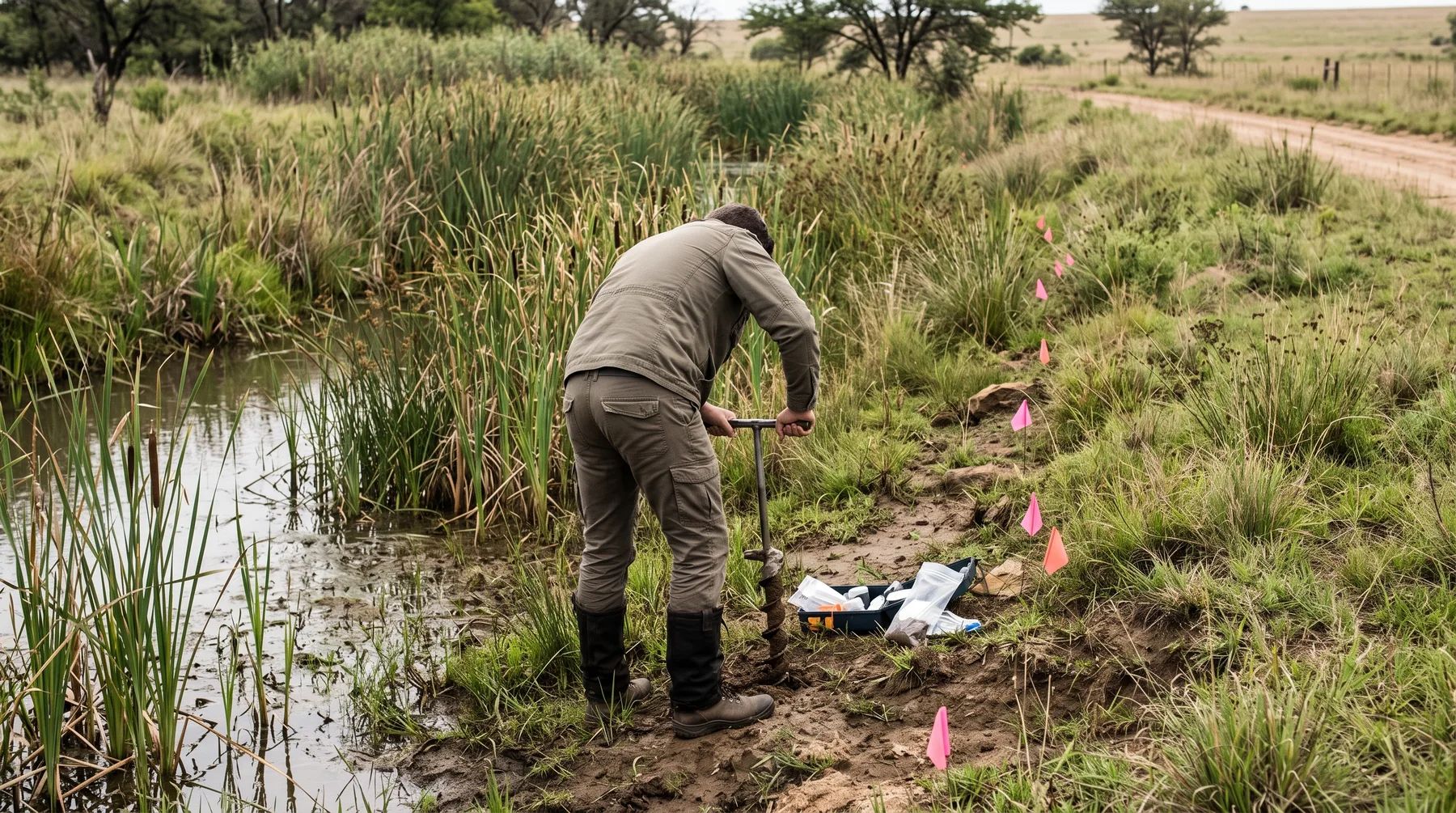
Any work that impedes or diverts the flow of a watercourse, or alters its bed, banks or characteristics, is a water use under section 21(c) and (i) of the National Water Act. Inside the regulated area of a watercourse, the Department of Water and Sanitation’s General Authorisation (GN 4167 of 8 December 2023) lets low-risk work go ahead on registration. Anything riskier, or anything the notice excludes, needs a full water use licence. The regulated area is built on the 1:100-year floodline, so the floodline decides where the rules start.
Working in or near a watercourse? We map the regulated area, model the effect of the work on flow, and prepare the registration or licence application.
Water use licence applicationsWhat the regulated area is
GN 4167 defines the regulated area of a watercourse as:
- “The outer edge of the 1 in 100-year flood line or delineated riparian habitat, whichever is the greatest distance, measured from the middle of the watercourse of a river, spring, natural channel, dams and lakes”;
- where neither has been determined, “the area within 100m distance from the edge of a watercourse”, the edge being the first identifiable annual bankfull flood bench (the notice adds “subject to compliance to section 144 of the National Water Act”);
- for a wetland or pan, “a 500 m radius around the delineated boundary (extent)”.
The 100 m fallback is not a buffer you can choose instead of a floodline: it applies only where no 1:100-year floodline or riparian delineation exists. A floodline study usually gives a narrower and more defensible regulated area than the fallback. Our post on the four lines that control building near a river compares the regulated area with NEMA’s 32 m trigger and municipal buffers. A common myth is that the Department uses a 32 m buffer; 32 m is a NEMA trigger, not part of this notice.
Low risk, or a licence
Inside the regulated area, the route depends on the risk:
- Risk matrix. A “suitably qualified SACNASP professional member” completes the Department’s risk matrix (Appendix A of the notice). A Low risk class can be registered under the General Authorisation.
- Medium or High risk. The notice “does not apply” to these, so they need a water use licence.
- No risk matrix needed. Appendix D1 lists activities any person may carry out without a risk matrix, subject only to the later conditions of clause 7. The appendix says conditions 7(7) to (12), which cover registration, record-keeping and compliance; clause 6(1)(i) says 7(4) to (12), which adds rehabilitation and monitoring, so confirm which apply with the regional office. They are emergency river crossings for vehicles to reach livestock, crops or homes; building a single residential house, with sewer connections under 120 l/s and any conservancy tank or French drain at least 100 m from a watercourse; maintaining private roads and crossings under 4 m wide on the same footprint; fences that do not impede or divert flow; solar projects that do not directly affect a watercourse; off-grid hydropower of 10 to 300 kW; and floating jetties and slipways. Appendix D2 does the same for named institutions such as Eskom, SANRAL, Transnet and Telkom.
- Approved river management plans. River and stormwater management work set out in a plan approved by the regional office or catchment management agency can go ahead without a separate risk matrix.
The registration documents are a master layout plan showing the work in relation to the delineated watercourses, the registration forms, the risk matrix signed by the SACNASP professional, and supporting information. The Department confirms registration “within 30 working days of the responsible authority being satisfied that the submission complies to all the requirements of this notice”, and work may start only once the registration letter is issued.
What the notice excludes
GN 4167 does not apply, and a water use licence is needed, where:
- the risk class is Medium or High;
- a licence is needed anyway for another section 21 water use linked to a new activity;
- “storage of water results” from the work, which catches most dams and weirs, and can catch berms and cofferdams;
- the work is on main or bulk sewers, French drains or pipelines carrying hazardous materials (conservancy tanks of no more than one per hectare, and internal sewer reticulation and minor connections to main sewers with flows under 120 l/s, are not excluded);
- it involves building water or wastewater treatment works, including package plants and septic tanks;
- it is “associated with any hazardous material within the regulated area”;
- it is mining or mining infrastructure, unless it falls under Appendix D1 or D2.
Wetland rehabilitation under General Authorisation 1198 of 2009 is also outside the notice; that authorisation covers it. Emergency incidents involving sewage or hazardous material infrastructure, or any of the excluded activities, can still be handled under the notice’s emergency protocol.
The conditions that come with registration
Registered work has to meet the notice’s conditions in clause 7. The headline ones:
- the work may not “detrimentally affect” the environment, other water users, property, or public health and safety;
- construction camps, vehicles, equipment, materials and chemicals stay outside the 1:100-year floodline or riparian habitat, and are removed within 30 days of finishing;
- baseline water quality is measured weekly for a month before the work starts, then weekly upstream and downstream until baseline values return;
- dated photographs are taken a week before, weekly during, and weekly for four weeks after the work;
- the watercourse is rehabilitated, and an environmental audit follows within six months of completion;
- records are kept for at least the first five years.
Our post on temporary works in rivers and floodplains covers the site conditions in more detail, including the emergency protocol for urgent repairs.
Where earlier authorisations stand
GN 4167 follows earlier general authorisations for these water uses: GN 398 of 2004, GN 1199 of 2009 and GN 509 of 2016. Users who used water under those “may continue with such water use without the requirement of re-registering”. The notice runs for 20 years unless it is replaced, amended or extended.
What to do first
- Map the regulated area: commission the 1:100-year floodline and the riparian delineation, or check whether the 100 m fallback applies.
- Check the exclusions: if the work stores water, involves sewers or hazardous material, or is mining, plan for a licence.
- Check Appendix D1: a single house, an emergency river crossing, maintenance of an existing private road crossing, or a fence may need registration only.
- Complete the risk matrix with a SACNASP professional, and register or apply through e-WULAAS.
See our water use licence applications and floodline determination services, or send us the site and the work you are planning.
This post explains the documents listed below. It is not legal advice; requirements change and are applied case by case, so confirm them with the relevant authority before relying on them.
Documents referenced
Links go to official government copies wherever one is published online. Check for amendments before relying on a specific clause.
- General Authorisation for water uses under section 21(c) and (i)Regulations · GN 4167 of 2023 · Department of Water and Sanitation
- National Water ActAct · Act 36 of 1998 · Department of Water and Sanitation
- e-WULAAS: online water use authorisationGuideline · Department of Water and Sanitation
Working on a site where flooding, stormwater, or floodlines are a concern? Send us a message about it and we’ll reply within one business day — no obligation.
Talk to an engineer