
Crossing a Watercourse? When You Need a Section 21(c) & (i) Water Use Licence
· Written by Robert Fortuin · Reviewed by Stephan Dreyer
If your project puts a structure in, over, or beside a watercourse — a culvert, a pipeline, a bridge, bank protection, an outfall — there is a good chance you need authorisation under the National Water Act before you build. It is one of the most commonly overlooked approvals on infrastructure and development projects, and discovering it late can stall a project that is otherwise ready to go. Here is when it applies and what the process looks like.
Putting a culvert, pipeline, or outfall in a watercourse? Find out whether you need a licence now rather than after the programme is committed — we handle the technical work these applications turn on.
Water use licence applicationsWhat Section 21(c) and (i) actually cover
The National Water Act (Act 36 of 1998) lists eleven categories of “water use” in Section 21. Two of them catch almost every watercourse crossing:
- Section 21(c) — impeding or diverting the flow of water in a watercourse.
- Section 21(i) — altering the bed, banks, course or characteristics of a watercourse.
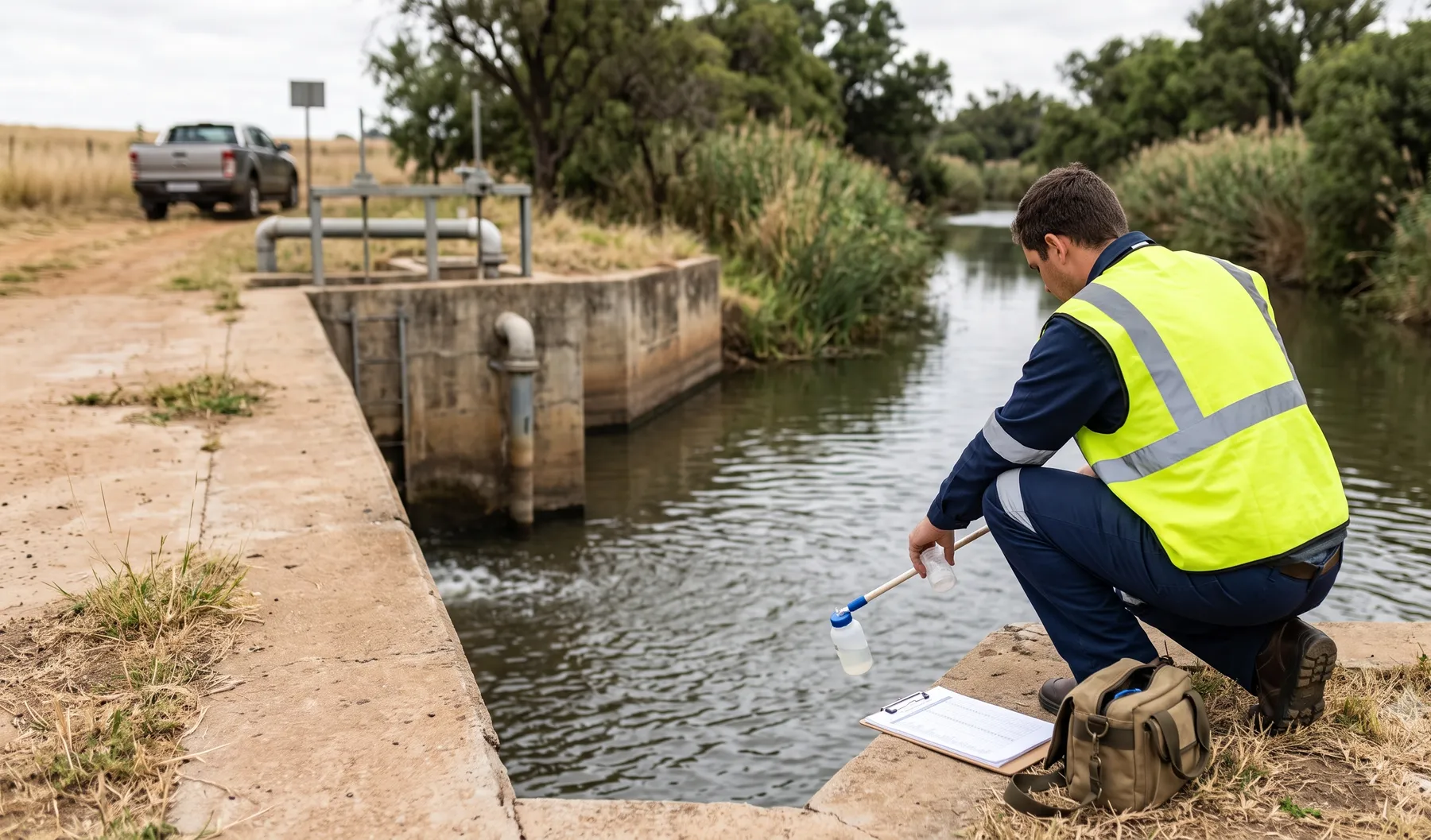
The important thing is that these are defined broadly. You do not have to abstract or pollute water to trigger them; physically changing or obstructing the watercourse is enough. A culvert impedes flow. Bank protection alters the banks. A pipeline crossing alters the bed. Nearly every crossing touches one or both, whether or not the project team realises it.
General Authorisation vs full licence
Not every 21(c)/(i) use needs a full licence. The Department of Water and Sanitation provides a General Authorisation (published under GN 509) that lets lower-risk uses proceed without a full Water Use Licence Application (WULA), subject to conditions. The decision between the two turns on a risk assessment — the DWS risk matrix — and on thresholds such as proximity to the watercourse (the well-known 500 m consideration for certain activities) and the scale and sensitivity of the impact.
In broad terms: lower-risk, smaller-scale crossings may qualify for the General Authorisation, which is faster; higher-risk, larger, or more sensitive works need a full WULA. Getting this call right early is what determines your timeline, so it is worth assessing before the programme is fixed rather than assuming the faster route.
What typically triggers it
On the projects we support, the usual triggers are:
- Culverts and drifts — impeding and diverting flow (culvert crossings).
- Pipelines and services crossing a river bed or bank (pipeline crossings).
- Bridges and their piers and abutments in the channel.
- Bank and bed protection — gabions, riprap, Reno mattresses altering the banks.
- Stormwater outfalls and attenuation outlets discharging to a watercourse.
If your project includes any of these, assume Section 21(c) and/or (i) is in play until a risk assessment says otherwise.
Realistic process and timeline
A General Authorisation registration is the quicker path but still requires the supporting assessment and documentation. A full WULA is a formal application with technical reports, a risk assessment, and often public participation, and it runs on DWS timelines that are measured in many months, not weeks. The single biggest scheduling mistake we see is treating the licence as a formality to be done in parallel with construction — it is a critical-path item, and it needs to start early.
What the application needs — and where the floodline fits
A credible application rests on technical evidence: a description of the works, a risk assessment, and hydrological and hydraulic support showing how the crossing behaves in flood — which is why a floodline determination and the crossing’s flood analysis usually feed directly into the WULA. The floodline is not a separate exercise; it is part of the evidence the application stands on.
See our water use licence applications service for how we assess the GA-vs-WULA route and compile the application, or get in touch early if your project involves any works in or near a watercourse.
Working on a site where flooding, stormwater, or floodlines are a concern? Send us a message about it and we’ll reply within one business day — no obligation.
Talk to an engineer