

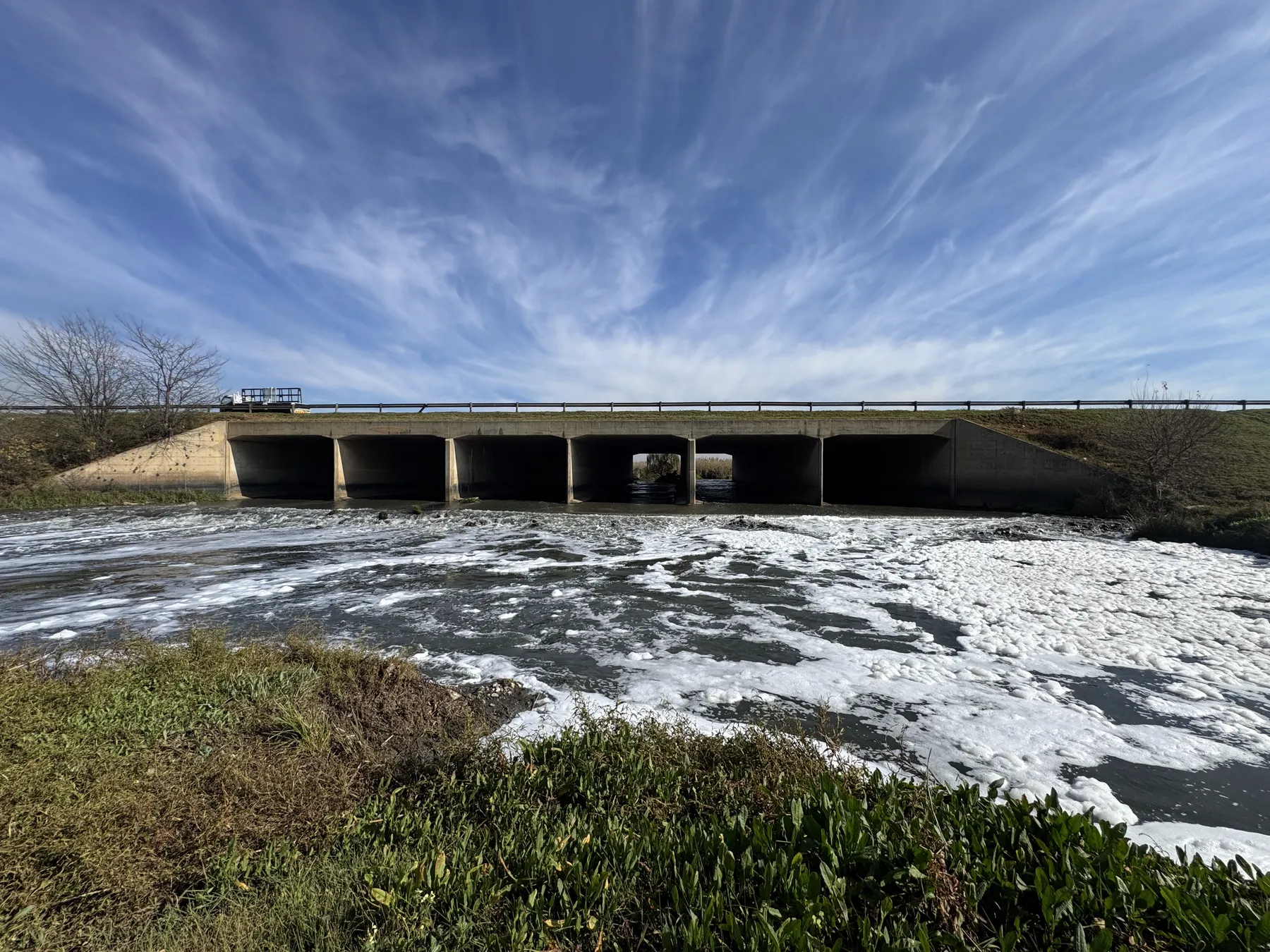
What Happens if You Build Inside a Floodline in South Africa?
· Written by Robert Fortuin · Reviewed by Stephan Dreyer
Sometimes the question is asked before the fact — “the floodline clips the corner of my erf; can I just build there anyway?” — and sometimes after it, when a structure already stands in the floodplain and a sale, insurance claim, or municipal letter has brought the issue to a head. Either way, the consequences follow a predictable pattern, and so do the legitimate ways out.
Floodline clipping your site, or a structure already standing in one? Many lines in circulation are old or desktop-derived. A rigorous determination on proper survey data sometimes moves the line — in either direction.
Floodline determinationBefore the fact: it usually stops at approval
If a current floodline exists for the property, building inside it without addressing the flood risk generally fails at the first gate. The Building Standards Act obliges a municipality to refuse plans for a site subject to flooding, and the 1:100-year floodline on a township layout plan — required by the National Water Act — makes the exposure a matter of record (our post on SANS 10400-H and flood risk walks through the legal machinery). Municipal building control near mapped watercourses routinely checks proposed structures against the floodline as a standard condition.
After the fact: the consequences compound quietly
A structure built inside a floodline — with no approval, or on plans that never disclosed the exposure — carries risks well beyond the obvious one of flooding:
- The physical risk is real, not theoretical. A “1-in-100-year” flood has roughly a 40% chance of occurring at least once over 50 years — run your own numbers with our flood risk calculator. Floodplains also carry flowing water: depth plus velocity is what damages structures and endangers people, not depth alone.
- Insurance. Insurers increasingly geocode flood exposure. Undisclosed floodplain siting can mean declined cover, loaded premiums, or a repudiated claim discovered at the worst possible moment — after the flood.
- Sale and financing. Conveyancing and bond due diligence increasingly surface floodline status. An unapprovable structure inside a floodline becomes a price negotiation at best, a failed transfer at worst.
- Enforcement and liability. Unapproved structures can attract demolition or regularisation orders. And an owner or developer who builds in a known floodplain and alters flows onto neighbours — or sells without disclosure — accumulates civil liability that outlasts the building work. Municipalities carry the mirror image of this burden: approving development in floodplains exposes the authority itself, which is why municipal clients are among the most careful users of floodline studies.
The legitimate ways forward
Being inside a floodline is a constraint, not necessarily a dead end. The defensible routes, roughly in order of preference:
1. Check whether the floodline is actually right. Many floodlines in circulation are old, desktop-derived, or deliberately conservative. A rigorous floodline determination on proper survey data and current methods sometimes moves the line meaningfully — in either direction. If the line is wrong, fix the line, not the rules.
2. Redesign around the line. Reposition buildings, shift the footprint, and use the floodplain for what it is good at — gardens, parking, open space. Usually the cheapest engineering solution available.
3. Engineer the risk down, with the authority’s agreement. Raised floor levels above the flood level with freeboard, flood-resilient foundation and material design, and in some cases channel improvements or protection works. These are negotiated on the strength of a flood risk assessment that quantifies depths, velocities, and frequencies — municipalities respond to numbers, not assurances. Note that filling or walling off a floodplain pushes water onto someone else and generally triggers water-use licensing of its own; “protection” that transfers the problem downstream is not a solution an authority will accept.
4. For existing structures: regularise honestly. A current flood study establishing the real exposure, followed by an application dealing with the risk explicitly — mitigation where feasible, disclosure where not. Slower than ignoring the letter from the municipality; considerably cheaper than litigating it.
The short version
Building inside a floodline does not usually fail loudly at the start — it fails quietly, later: at claim time, at transfer, at enforcement, or in a flood. Every legitimate way forward starts from the same place: knowing precisely where the line is and how deep and fast the water gets. If that is the question on your site, we can answer it.
Working on a site where flooding, stormwater, or floodlines are a concern? Send us a message about it and we’ll reply within one business day — no obligation.
Talk to an engineer