

GN 704 Regulation 4: Floodlines, the 100 m Rule and Clean and Dirty Water on Mines
· Written by Robert Fortuin · Reviewed by Stephan Dreyer
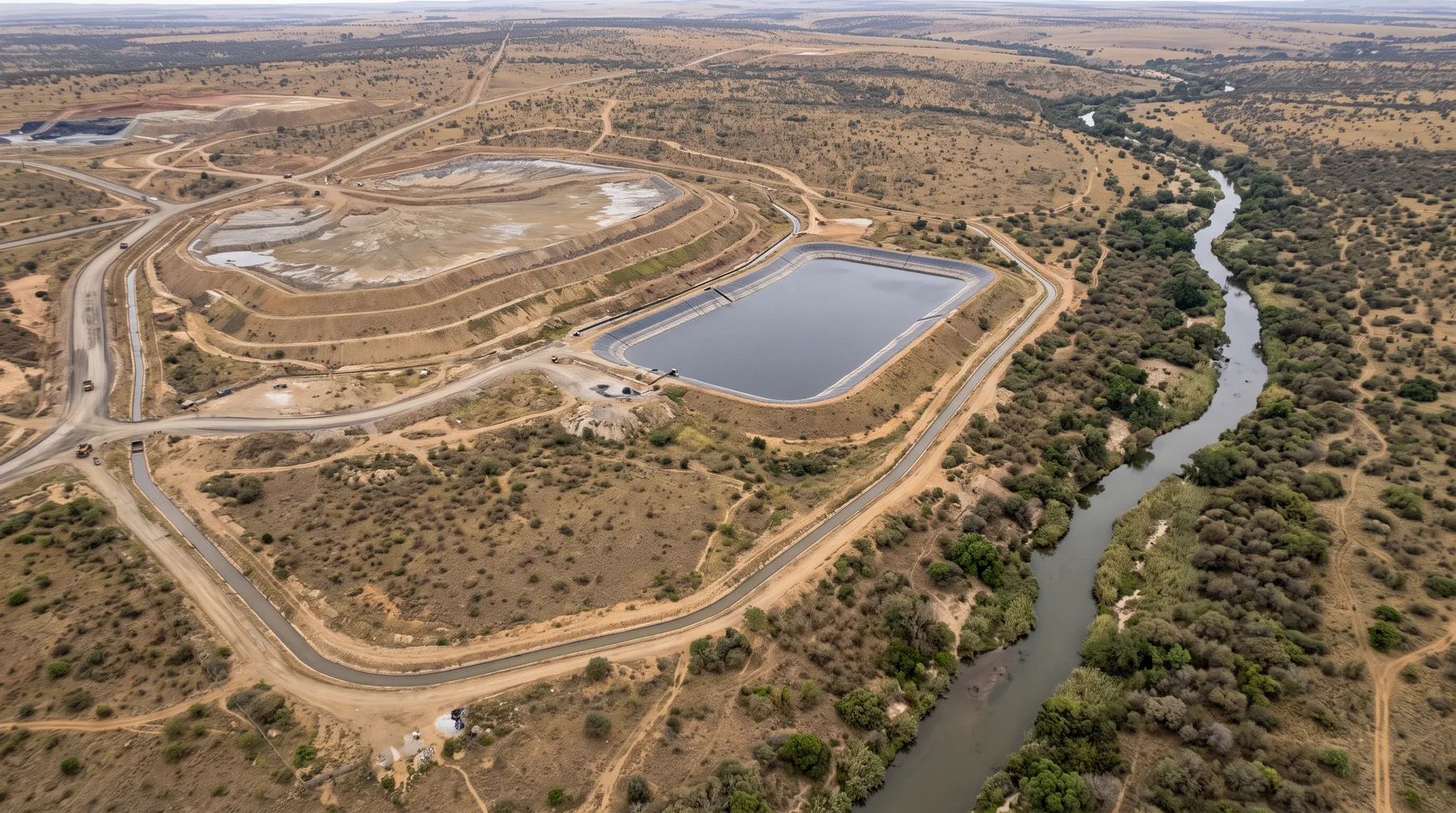
GN 704 of 4 June 1999, the regulations on the use of water for mining, sets where mine infrastructure may go relative to floodlines and watercourses. Regulation 4 keeps residue deposits, dams and reservoirs outside the 1:100-year floodline and at least 100 m from any watercourse. It keeps mining itself outside the 1:50-year floodline or 100 m from a watercourse, whichever is greater. Regulation 6 then sets how clean and dirty water must be kept apart. Most mine floodline studies exist to answer these two regulations.
Siting a residue facility, a pollution control dam or a new pit near a watercourse? We determine the 1:50 and 1:100-year floodlines and size the clean and dirty water systems to GN 704.
Mine water managementRegulation 4: where infrastructure may go
| Regulation | What it restricts | The limit |
|---|---|---|
| 4(a) | Residue deposits, dams, reservoirs, associated structures “or any other facility” | Not within the 1:100-year floodline, and not within a horizontal distance of 100 m from any watercourse or estuary, borehole or well (monitoring boreholes excepted). Also not on water-logged, undermined, unstable or cracked ground |
| 4(b) | Underground or opencast mining, prospecting “or any other operation or activity” | Not under or within the 1:50-year floodline, or within 100 m of any watercourse or estuary, “whichever is the greatest”. Sand and alluvial mining under regulation 10 is excepted |
| 4(c) | Residue or substances likely to pollute a water resource | Not placed or disposed of in the workings of any underground or opencast mine |
| 4(d) | Sanitary conveniences, fuel depots, reservoirs, and depots for substances likely to cause pollution | Not within the 1:50-year floodline of any watercourse or estuary |
Three points are often misread:
- “Whichever is the greatest” appears only in 4(b). Regulation 4(a) lists the 1:100-year floodline and the 100 m distance as two separate limits. The Department’s guideline on the regulations (M6.1, 2000) says 4(a) “should be interpreted similarly”, so a facility has to clear both.
- 4(d) has no 100 m distance. Fuel depots and sanitation are tied to the 1:50-year floodline only.
- The limits work from the floodline. The guideline says the 1:100-year floodline “should be determined by a suitably qualified person”. Where no floodline exists, the 100 m distance alone does not show compliance with 4(a).
Regulation 6: clean and dirty water
Regulation 6 requires every mine to:
- keep unpolluted water in a clean water system, away from dirty areas;
- design, build and run the clean water system so it is “not likely to spill into any dirty water system more than once in 50 years”;
- collect water from dirty areas, including seepage, into a dirty water system that is not likely to spill into the clean system more than once in 50 years;
- give any dam or tailings dam in a dirty water system “a minimum freeboard of 0.8 metres above full supply level”, unless Chapter 12 of the National Water Act (dam safety) specifies otherwise;
- size channels, pipes and other conveyances for the flood with a 1 in 50-year recurrence.
The guideline warns that these requirements “do not necessarily guarantee the safety of a dam”. A large dirty water dam or tailings dam can also be a dam with a safety risk under Chapter 12, with its own classification and design flood. Our post on the Dam Safety Regulations explains that test.
Exemptions
Regulation 3 lets the Minister exempt a mine from regulations 4, 5, 6, 7, 8, 10 or 11, either on the Minister’s own initiative or on application, with conditions. Regulations 2, 9, 12 and 13 cannot be exempted.
The Department’s guideline describes a formal application for exemption to the regional office. Where the exemption would mean a water use licence is needed, the two run together: the 2017 procedural regulations for licence applications (GN R267) ask for a “GN 704 Motivation” in the checklist for waste-related water uses under section 21(g). The guideline adds that “a water use licence has higher authority than the regulations”. Either way, the motivation needs the floodlines and the water management design to show what the exemption would allow and why the risk is acceptable.
Notification duties
Regulation 2 also sets notification duties:
- anyone intending to operate a new mine or activity must notify the Department at least 14 days before starting;
- the person in control of a mine (including the owner, lessee and any lawful occupier) must give 14 days’ notice before stopping or restarting operations, and must report any emergency incident involving a water resource “by the fastest possible means”, and follow up in writing within 14 days with the measures taken.
GN 704 came into force on 4 June 1999, and the guideline states that the regulations “may not legally be applied retrospectively”. It adds that they “lay down certain minimum requirements that should be complied with”, and expects existing mines to improve progressively.
What a GN 704 floodline study covers
A mine floodline study is usually bigger than a township one:
- the 1:50 and 1:100-year floodlines for every watercourse near the residue deposits, dams, pits, plant and fuel depots;
- the 100 m line from each watercourse, borehole and well;
- watercourses that earlier mining has diverted or canalised, modelled as they now are;
- the 1:50-year flows for sizing clean water diversions and dirty water conveyances;
- the inputs for freeboard and spill checks on dirty water dams.
The results usually feed a water use licence application, so the report has to stand up to review by the Department as well as the mine’s own engineers. Our post on what drives the cost of a floodline study includes a mine example.
See our mine water management and floodline determination services and our mining sector page, or send us the site layout.
This post explains the documents listed below. It is not legal advice; requirements change and are applied case by case, so confirm them with the relevant authority before relying on them.
Documents referenced
Links go to official government copies wherever one is published online. Check for amendments before relying on a specific clause.
- Regulations on use of water for mining and related activitiesRegulations · GN 704 of 1999 · Department of Water and Sanitation
- Operational Guideline M6.1: Guideline document for the implementation of regulations on use of water for mining and related activitiesGuideline · Second edition, May 2000 · Department of Water Affairs and Forestry
- Regulations regarding the procedural requirements for water use licence applications and appealsRegulations · GN R267 of 2017 · Department of Water and Sanitation
- National Water ActAct · Act 36 of 1998 · Department of Water and Sanitation
Working on a site where flooding, stormwater, or floodlines are a concern? Send us a message about it and we’ll reply within one business day — no obligation.
Talk to an engineer