

Temporary Works in Rivers and Floodplains: What Needs Authorisation
· Written by Stephan Dreyer · Reviewed by Robert Fortuin
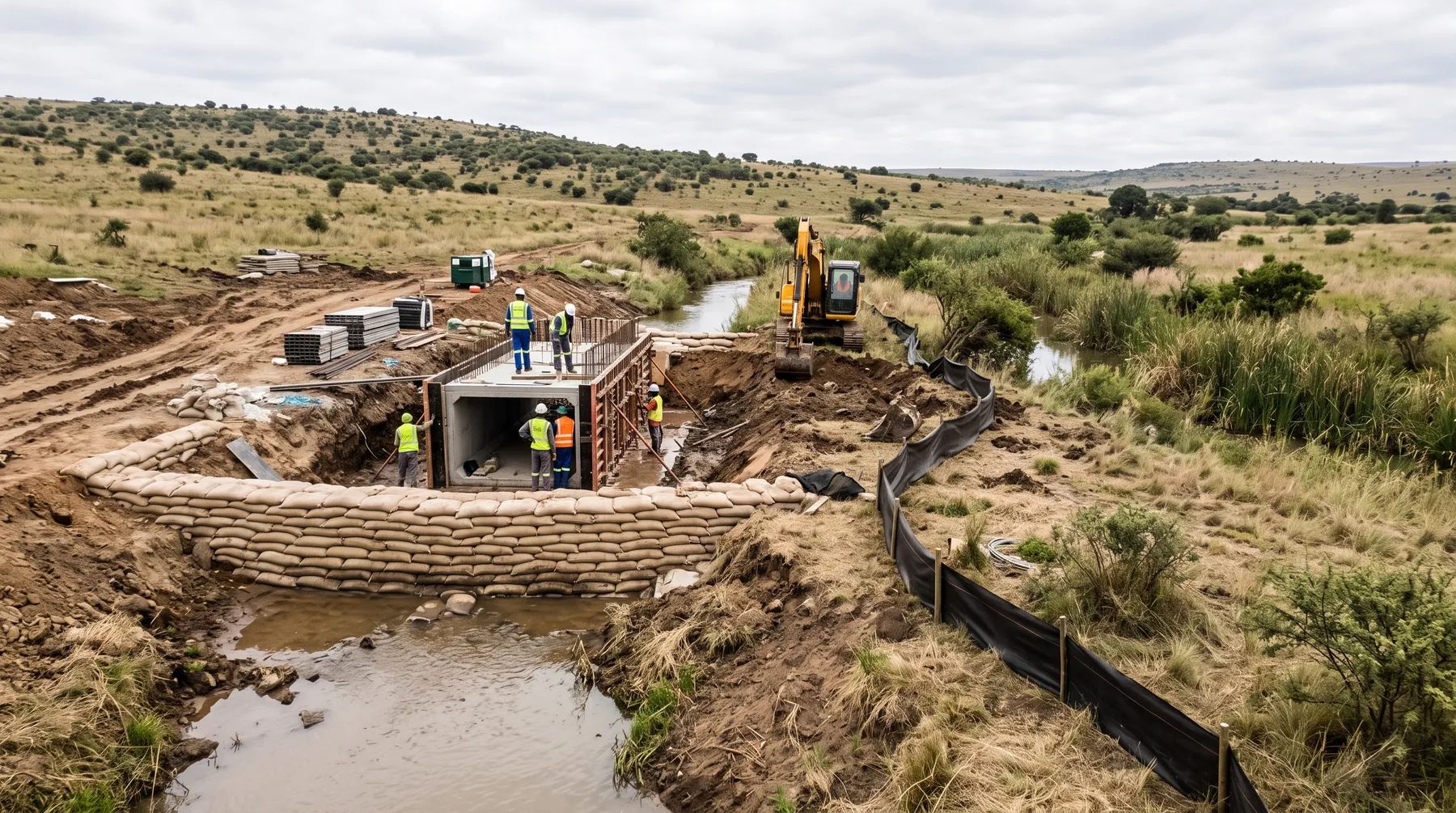
Temporary works in a river are regulated in much the same way as permanent ones. The National Water Act has no exemption for work that will be removed later: a cofferdam, a flow diversion or a temporary haul-road crossing impedes or diverts flow, which makes it a section 21(c) and (i) water use. The water use General Authorisation also controls where construction camps and materials may go. Only the environmental regulations give temporary structures a limited break.
Need to work in or across a river during construction? We design the temporary works, model what they do to flood levels, and prepare the water use registration before work starts.
Water use licence applicationsWater use: no temporary exemption
The General Authorisation for section 21(c) and (i) uses (GN 4167 of 2023) defines impeding as “to, in any manner, hinder or obstruct the instream flow of water temporarily or permanently”, and diverting as causing the flow “to be rerouted temporarily or permanently”. The words “temporary works” and “cofferdam” do not appear in the notice; it does not need them.
So temporary works inside the regulated area of a watercourse need either registration under the General Authorisation or a water use licence. The regulated area is the 1:100-year floodline or riparian edge, otherwise 100 m from the watercourse, and 500 m around a wetland. Registration requires a Low rating on the DWS risk matrix, completed by a SACNASP-registered professional. Two exclusions often catch temporary works:
- The notice does not apply “where storage of water results” from the work. A cofferdam that ponds water upstream may fall here.
- It does not apply to work “associated with any hazardous material within the regulated area”, such as a pipeline carrying hazardous material. Keep fuel and chemicals outside the 1:100-year floodline, as condition 7(3) requires; whether fuel handling inside the regulated area triggers this exclusion is unclear.
Either exclusion sends the work to a full licence. Confirm with the Department’s regional office or the catchment management agency where it is unclear.
Conditions on the site
The General Authorisation’s conditions (clause 7) set out how temporary works must be run:
- Camps and storage: “any construction camp; storage of vehicles; any storage, washing and maintenance of equipment, and any storage of construction materials and/or chemicals; as well as any sanitation and waste management facilities” must be outside the 1:100-year floodline or riparian habitat, and “removed within 30 days after the completion of any works”.
- Footprint: a demarcated maximum impact footprint, with no vegetation cleared beyond it.
- Location and sequence: not on a bend in the watercourse, and work proceeding from upstream to downstream where feasible.
- Bed and bank material: stockpiled at a demarcated location and returned where it came from: bed material to the bed, bank material to the banks.
- Records: dated photographs a week before, weekly during, and weekly for four weeks after the works.
- Water quality: baseline measurements weekly for a month before work, weekly upstream and downstream during it, and an environmental audit within six months of completion.
- Rehabilitation: the watercourse restored to its condition before the work, re-vegetated with indigenous plants, with alien plants controlled.
Work may start only once the Department has issued the registration letter.
Environmental authorisation: a 6-week break, with limits
Listing Notice 1 of the NEMA EIA regulations lists structures with a footprint of 100 m² or more within a watercourse or within 32 m of one (activity 12). It excludes “the development of temporary infrastructure or structures where such infrastructure or structures will be removed within 6 weeks of the commencement of development and where indigenous vegetation will not be cleared”.
Activity 12 also does not apply inside urban areas or within existing road reserves. These exclusions apply to activity 12 only. Activity 19, moving more than 10 m³ of material into or out of a watercourse, has no temporary exclusion: a cofferdam or causeway built from fill can trigger it. A haul road can trigger activity 24 if its reserve is wider than 13.5 m (or the road wider than 8 m where there is no reserve), unless it is 1 km or shorter or entirely in an urban area. Have an environmental assessment practitioner confirm which activities apply before work starts.
Municipal rules
| Municipality | What applies to temporary works | Source |
|---|---|---|
| Cape Town | Written Council consent to build anything that may “interfere with or endanger the stormwater system”, or to “fill, excavate, shape, landscape, open up or remove the ground above, within, under or immediately next to any part of the stormwater system”. Watercourses and their floodplains are part of the system | Stormwater Management By-law 2005, s4 |
| Johannesburg | Permits for grading of 100 m³ or more, temporary or permanent slopes steeper than 3:1 and higher than 1.5 m, and berms impounding more than 450 mm or 50 m³. “Every structure such as a dam, dike or diversion, whether temporary or permanent, must be stabilised”; temporary conveyance channels must be stabilised against erosion from the 2-year storm; temporary erosion and sediment controls removed within 30 days | Stormwater Management By-laws 2010, ss5, 19, 21, 25 |
Designing temporary works for floods
Temporary works fail when they are designed for the river on the day they are built. A cofferdam overtopped by a storm in the middle of construction can wash out, carry fill downstream and flood the works. Size diversions and cofferdams for a flood that matches the construction period and the consequence of failure, plan for overtopping, and keep the programme clear of the wet season where possible.
A large cofferdam can be a dam in law: the National Water Act defines a dam to include “temporary impoundment”. One that could hold more than 50 000 m³ behind a wall higher than 5 m would meet the definition of a dam with a safety risk; check with the Dam Safety Office.
Emergency work after a flood
After a flood, repairs often cannot wait for an authorisation. Two parallel processes cover this:
Water use: the DWS emergency protocol (GN 4167, Appendix C). It applies to emergency work connected with an existing water use entitlement, and “does not include routine or planned maintenance or to deal with poor project planning”. The person acting must:
- notify the regional office or catchment management agency “immediately within 24 hours”, by email or the Department’s hotline;
- submit the documents for the planned work within 14 days;
- submit a final report within 3 months, including a risk assessment by a SACNASP-registered professional and a rehabilitation plan. The Department then decides whether the work can be registered under the General Authorisation or needs a licence after the fact.
Work under the protocol is subject only to conditions 7(7) to 7(12) of the notice: registration, records, inspection and compliance. Work that is not linked to an existing water use entitlement is not covered; contact the regional office before starting.
Environment: a NEMA section 30A directive. The competent authority “may on its own initiative or on written or oral request from a person, direct a person verbally or in writing to carry out a listed or specified activity, without obtaining an environmental authorisation” to deal with an emergency. A verbal directive must be confirmed in writing within seven days. If the authority declines, the work may not go ahead without an environmental authorisation. After the September 2023 floods, the Western Cape environment department received 238 applications for emergency river repairs and finalised 196 of them using section 30A.
A section 30A directive covers the environmental side only; it does not authorise the water use, and the DWS protocol does not replace it. Where the work is both a water use and a listed activity, you need both. Our post on rebuilding after a flood covers the building plans a flood-damaged house needs.
Before work starts
- Map the regulated area and the 32 m line around the work site.
- Design the temporary works, and model their effect on flood levels during construction.
- Complete the risk matrix and register the water use, or apply for a licence.
- Confirm the NEMA position with an environmental assessment practitioner.
- Get the municipal consents, and set up the camp and stockpiles outside the floodline.
See our water use licence and hydraulic modelling services, or send us the works programme.
This post explains the documents listed below. It is not legal advice; requirements change and are applied case by case, so confirm them with the relevant authority before relying on them.
Documents referenced
Links go to official government copies wherever one is published online. Check for amendments before relying on a specific clause.
- General Authorisation for water uses under section 21(c) and (i)Regulations · GN 4167 of 2023 · Department of Water and Sanitation
- National Water ActAct · Act 36 of 1998 · Parliament of South Africa
- EIA Regulations Listing Notice 1 (as amended)Regulations · GN 327 of 2017 · Department of Environmental Affairs (gazette copy hosted by KZN EDTEA)
- National Environmental Management Laws Second Amendment Act (inserts NEMA section 30A)Act · Act 30 of 2013 · Parliament of South Africa
- Application form for section 30A emergency authorisationGuideline · KZN Department of Economic Development, Tourism and Environmental Affairs
- Stormwater Management By-laws, 2010By-law · City of Johannesburg
- Stormwater Management By-law, 2005By-law · City of Cape Town
Working on a site where flooding, stormwater, or floodlines are a concern? Send us a message about it and we’ll reply within one business day — no obligation.
Talk to an engineer