

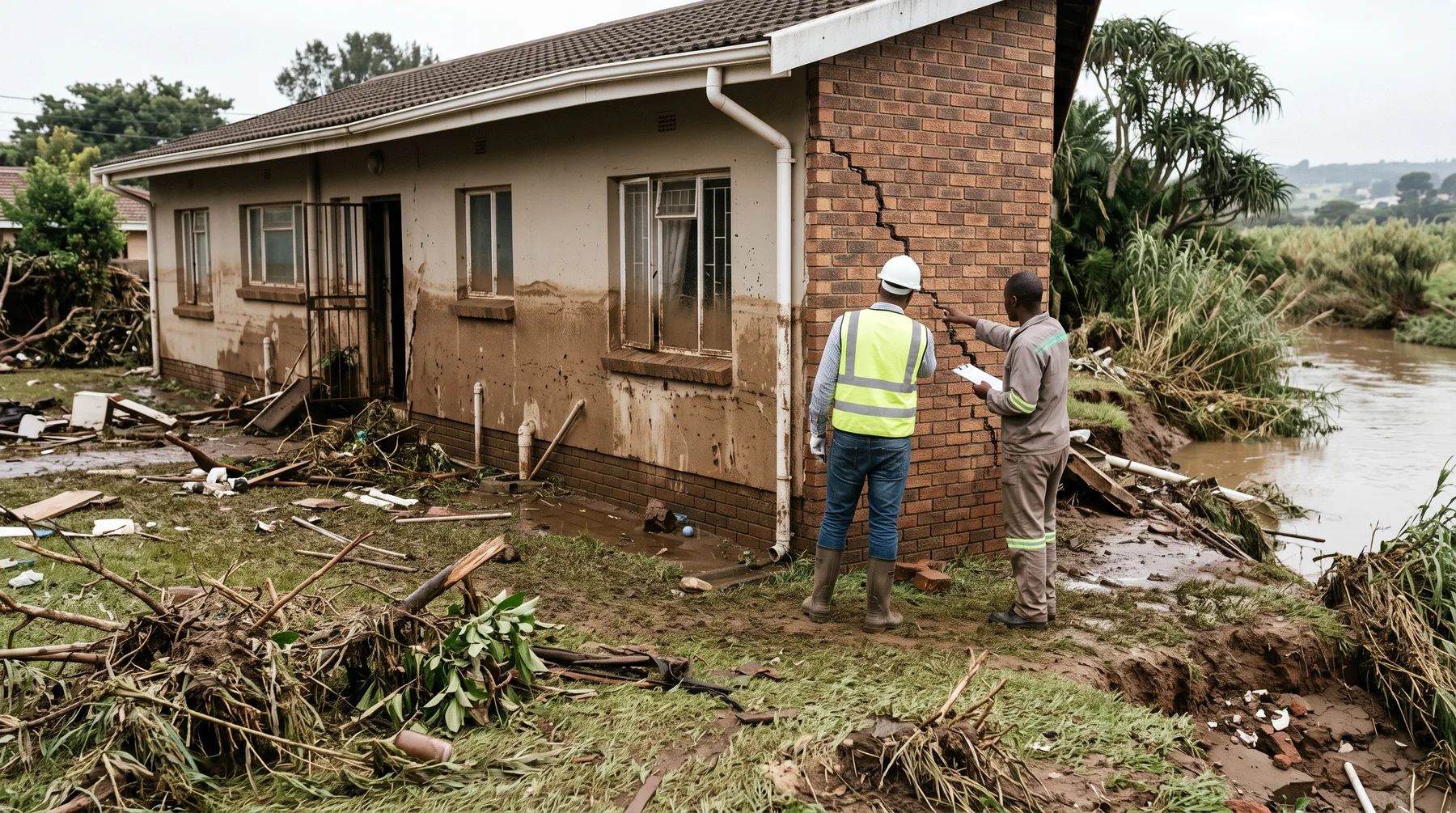
Rebuilding After a Flood in South Africa: The Approvals You Need Inside a Floodline
· Written by Robert Fortuin · Reviewed by Stephan Dreyer
Rebuilding a flood-damaged building usually needs approved building plans, and on a flood-prone site the municipality can refuse them or attach conditions. The Building Standards Act counts rebuilding, and any repair to a building’s structural system, as “erection”. Section 10 of the Act lets a municipality prohibit building on a site “subject to flooding” or allow it only on its conditions. Repairs in the river itself, such as bank protection, crossings and culverts, need separate water use and environmental approvals, with emergency routes for work that cannot wait.
Deciding whether and how to rebuild? We record the flood levels, check the site against the floodline, and recommend floor levels and protection the municipality can approve.
Flood damage assessmentWhich repairs need building plans
The Act defines “erection” to include “the alteration, conversion, extension, rebuilding, re-erection, subdivision of or addition to, or repair of any part of the structural system of, any building”. Under section 4, no one may erect a building without the municipality’s prior written approval of the plans.
In practice:
- Rebuilding a demolished or collapsed building needs plans, even on the same footprint.
- Structural repairs, such as foundations, load-bearing walls and roof structure, need plans.
- Finishes and fittings, such as plaster, flooring, kitchens and doors, are not repairs to the structural system. Ask the building control officer if you are unsure where the line falls on your building.
A rebuild may be assessed against the rules in force now rather than those the original building was approved under. Existing rights under the land use scheme can help, so check what the scheme and any floodplain policy say about rebuilding. A house approved decades ago, before the floodline was drawn, may not be approvable in the same form today.
What the municipality can do on a flood-prone site
Two sections of the Act give the municipality room to say no:
- Section 7 obliges it to refuse plans if it is satisfied the building “will probably or in fact be dangerous to life or property”.
- Section 10 lets it act where a building or earthwork “is being or is to be erected on a site which is subject to flooding”. It may, by written notice, prohibit the work or allow it only “on such conditions as such local authority may determine from time to time”.
Conditions on a flood-prone site usually cover floor levels above the 1:100-year flood, foundations designed for scour and saturated soil, no filling that pushes water onto neighbours, and sometimes a restriction registered against the title. Our posts on freeboard and floor levels and filling in a floodplain explain the reasoning behind each.
Municipal floodplain rules that limit rebuilding
Land use schemes and policies add zone-by-zone limits. A flood often shows that a building sits in a zone where the current rules would not allow it:
| Municipality | Rule | Source |
|---|---|---|
| Cape Town | No new or existing rights exercised in the high hazard zone (deep or fast water in the 1:100-year flood). Formal residential development not permitted below the 1:50-year line; between the 1:50 and 1:100-year lines, floors above the 1:100-year level and basements flood-proofed to the 1:50-year level. Informal housing not permitted below the 1:100-year line. Redeveloping an existing building with no increase in footprint or use can be considered outside the high hazard zone, with an engineer’s certificate, floors above the 1:100-year level and a deed of restraint. Building plans under existing rights: floors above the 1:100-year level where practically possible, and no buildings in the high hazard zone | Floodplain and River Corridor Management Policy 2009, sections 10.2.2 and 10.3 |
| Msunduzi (Pietermaritzburg) | No habitable buildings within the 1:50-year line; ground floors at least 300 mm above the highest flood on record for the land | Single Land Use Scheme 2024, cl 5.43 |
| George | The City may refuse new permanent residential, commercial or industrial development under the 50-year line | Stormwater By-law 2023, s26 |
| Nelson Mandela Bay | The Municipality may prohibit buildings, or set conditions, within the 50- to 100-year floodline | Land Use Scheme 2023, cl 56 |
| Mbombela | No building below the 1:100-year line unless the City approves the construction method | Land Use Scheme 2019, cl 5.17.2(d) |
Our posts on building between the 1:50 and 1:100-year floodlines and permission to build in a floodplain cover the other metros, and our city pages list each municipality’s rules.
Repairs in and next to the river
Repairing an eroded bank, a culvert, a crossing or a weir is work in a watercourse. It needs water use authorisation, and it can need environmental authorisation too. After a flood, two emergency routes exist:
- Water use: the DWS emergency protocol in Appendix C of GN 4167. It covers emergency work linked to an existing water use entitlement. Notify the regional office or catchment management agency within 24 hours, submit the documents within 14 days, and submit a final report within three months. The Department then decides whether the work can be registered under the General Authorisation or needs a licence after the fact.
- Environment: a NEMA section 30A directive. Where the repair is a listed activity, for example moving more than 10 m³ of material in a watercourse, the environmental authority can direct that it go ahead without prior environmental authorisation to deal with the emergency.
The two are separate: a section 30A directive does not authorise the water use, and the DWS protocol does not replace environmental authorisation. Neither covers rebuilding a house. Our post on temporary works in rivers and floodplains sets out both processes in full. Once the emergency is over, permanent works go through the normal route: see the regulated area of a watercourse and the NEMA 32 m rule.
Record the flood before you clean up
The flood that damaged the building is the best evidence of how high water reaches on the site. Before cleaning up, photograph and mark the debris lines and water marks on walls, fences and trees, and have a surveyor level them. Those levels let an engineer check whether the existing floodline still holds, set floor levels for the rebuild, and support an insurance claim. In Durban, eThekwini has said that floods in 2017, 2019, 2022 and 2023 exceeded the 1:100-year flood in parts of the city, which is one reason floodlines go out of date.
The order that avoids rework
- Make it safe. Ask the municipality’s building control section to inspect structural damage before anyone re-enters or repairs.
- Record the flood levels and the damage, with dates and photographs.
- Check the floodline and the zone the building sits in, and whether the scheme still allows the use there.
- Decide repair, raise or relocate, using the recorded levels and an updated floodline where the old one no longer holds.
- Submit plans that answer the section 10 question up front: floor levels, foundations, and no harm to neighbours.
- Run river repairs through the emergency protocol and section 30A only while the emergency lasts, and through the normal authorisations after it.
See our flood damage assessment and floodline determination services, or send us the site and what happened.
This post explains the documents listed below. It is not legal advice; requirements change and are applied case by case, so confirm them with the relevant authority before relying on them.
Documents referenced
Links go to official government copies wherever one is published online. Check for amendments before relying on a specific clause.
- National Building Regulations and Building Standards ActAct · Act 103 of 1977 · Parliament of South Africa
- General Authorisation for water uses under section 21(c) and (i)Regulations · GN 4167 of 2023 · Department of Water and Sanitation
- National Environmental Management Laws Second Amendment Act (inserts NEMA section 30A)Act · Act 30 of 2013 · Parliament of South Africa
- Floodplain and River Corridor Management PolicyPolicy · City of Cape Town
- Single Land Use Scheme (October 2024)By-law · Msunduzi Municipality
- By-law relating to Stormwater, 2023By-law · George Municipality
- Nelson Mandela Bay Land Use Scheme 2023 (Provincial Gazette 4981)By-law · Nelson Mandela Bay Metropolitan Municipality
- City of Mbombela Land Use Scheme 2019By-law · City of Mbombela
- Statement by eThekwini Mayor on the recent storm disaster (3 March 2025)Policy · eThekwini Municipality
Working on a site where flooding, stormwater, or floodlines are a concern? Send us a message about it and we’ll reply within one business day — no obligation.
Talk to an engineer