

Energy Dissipators: Slowing Water Down Before It Destroys Your Channel
· Written by Stephan Dreyer · Reviewed by Robert Fortuin
The damage at a culvert or spillway outlet is rarely about how much water comes out. It is about how fast. Water leaving a structure carries kinetic energy that has to go somewhere, and if you do not deliberately dissipate it, it dissipates itself — by tearing a scour hole out of your channel and working back toward the structure. An energy dissipator’s whole job is to take that energy out of the flow on purpose, in a place you control.
Scour hole opening up below a culvert or spillway outlet? We size the dissipator to the energy actually leaving the structure — and check the tailwater that decides whether it works.
Culvert designWhy outlet velocity, not flow volume, does the damage
A culvert concentrates flow and often accelerates it, so water can leave the outlet considerably faster than the downstream channel can tolerate. The erosive power of flowing water rises steeply with velocity, which is why a modest flow at high speed can do more damage than a larger flow moving slowly. The design problem is therefore to convert velocity into turbulence and heat — to slow the water — before it reaches erodible ground. Everything below is a different way of doing that.
The options ladder
Energy dissipation is best thought of as a ladder, from the simplest to the most robust, matched to how much energy you need to kill:
- Riprap aprons — a bed of rock at the outlet that adds roughness and spreads the flow. Cheapest and simplest, suitable for modest outlet velocities. Beyond a certain velocity the rock itself moves and you need something more.
- Impact and baffle structures — concrete blocks or baffles placed in the flow path that the water slams into, forcing turbulence. Compact and effective for a defined range of flows.
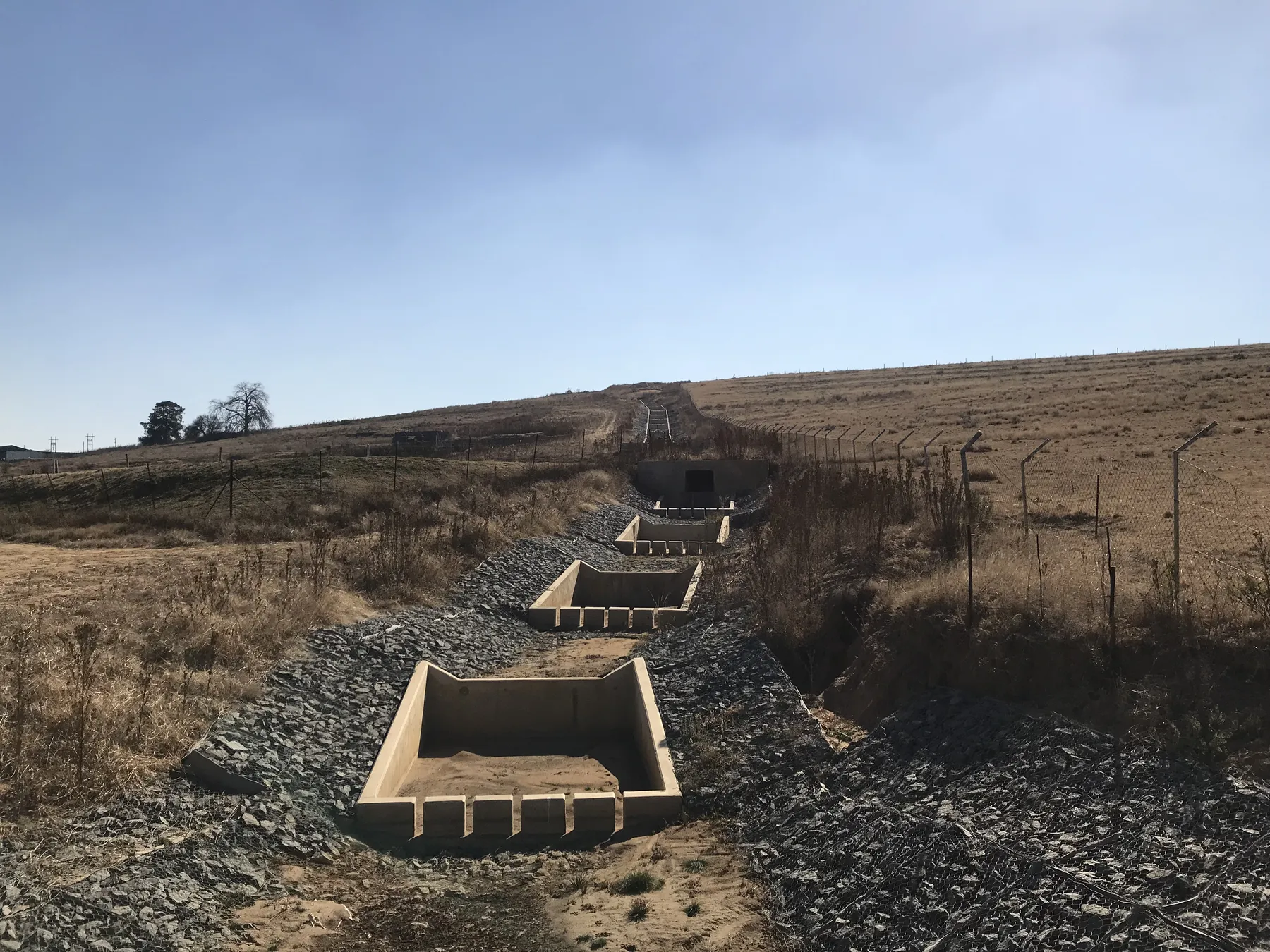
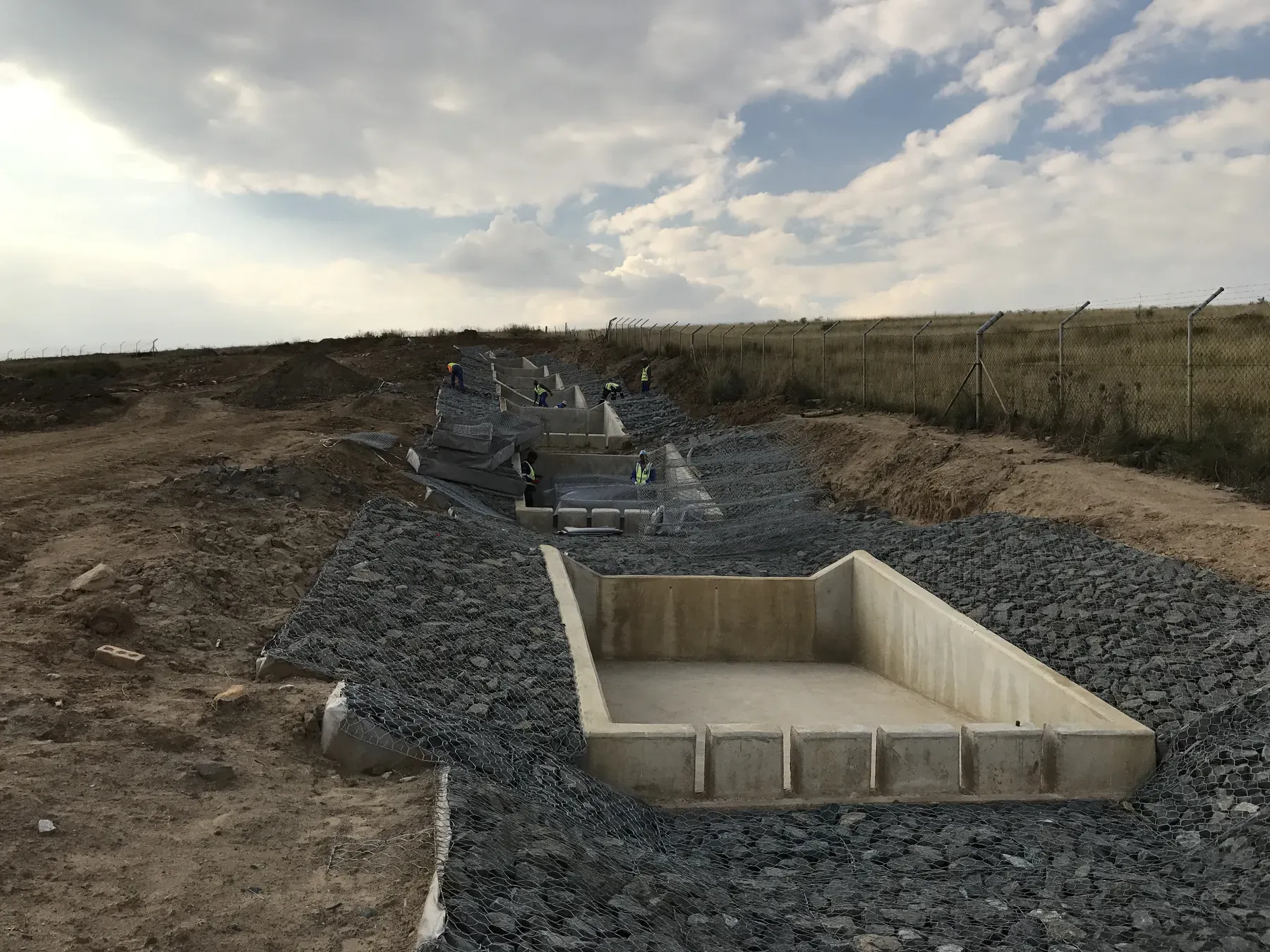
- Stilling basins — a purpose-shaped basin that forces a hydraulic jump, the abrupt transition from fast, shallow flow to slow, deep flow that dissipates a large fraction of the energy in a short length. The workhorse for larger structures where the tailwater conditions suit a jump.
- Stepped chutes — a series of steps down a steep drop that dissipate energy progressively, step by step, all the way down rather than all at once at the bottom.
When a stepped chute beats a stilling basin
The choice between a stilling basin and a stepped chute often comes down to the drop. On a steep, long descent — the kind of grassed slope where you need to lower water a significant height — a stepped chute dissipates energy continuously down the face, so it arrives at the bottom already slowed and needs a much smaller terminal structure. A stilling basin, by contrast, lets the water accelerate down a smooth chute and then kills all that energy in one violent jump at the base, which demands a robust, well-founded basin and reliable tailwater. Steep, long drops frequently favour the stepped approach for exactly this reason.
Sizing principles without the maths
You do not need the equations to understand what a design is balancing: the incoming velocity and energy (from the structure and the drop), the tailwater depth (which determines whether a hydraulic jump will form and stay put), and the downstream channel’s tolerance. A stilling basin that assumes a tailwater that is not actually there will not form its jump, and the energy passes straight through to the channel. Matching the dissipator to the real tailwater is where the engineering sits.
Pair dissipation with downstream protection
Even a good dissipator leaves the flow with some residual energy, so the transition back to the natural channel still needs erosion protection — a riprap or gabion apron sized for the slowed-but-not-stopped flow. Dissipation and protection are a pair; doing one without the other just relocates the scour hole. And the whole question only arises because of what happens at culvert outlets under load in the first place.
See our scour and erosion protection and culvert design services for outlet-structure design, or get in touch if an outlet on your project is scouring the channel below it.
Working on a site where flooding, stormwater, or floodlines are a concern? Send us a message about it and we’ll reply within one business day — no obligation.
Talk to an engineer