

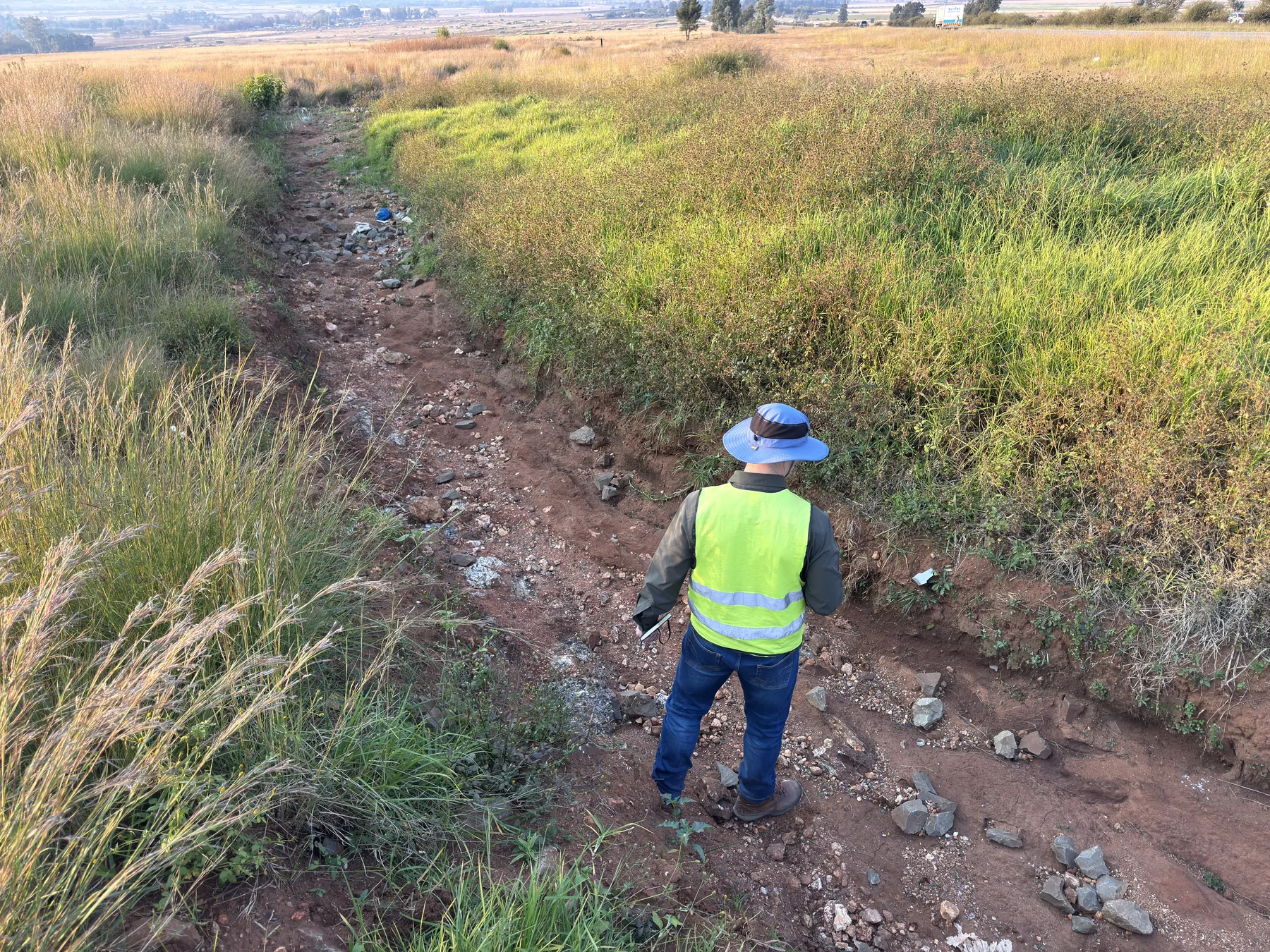
Why Erosion Protection Fails: Field Lessons from Riprap and Gabion Failures
· Written by Stephan Dreyer · Reviewed by Robert Fortuin
Walk enough failed erosion protection and a pattern emerges: the rock or the gabion mesh is usually still there. The structure did not wear out in the middle — it unravelled from an edge. Understanding where and why erosion protection fails is more useful than any single sizing rule, because the failure almost never starts where people look.
Protection failing on your site, or about to specify some? We assess why it went and design the terminations, toe, and filter that decide whether the next one survives.
Scour and erosion protectionFailures start at edges, toes, and terminations
Riprap, gabions, and mattresses are protecting the soil underneath and beside them. The moment flowing water finds an unprotected boundary — the downstream termination, the toe where the protection meets the bed, the edge where it meets an untreated bank — it attacks the soil there and works its way under the protection. Once water is moving beneath the layer, the whole panel is being undermined from below, and it slumps into the scour hole it created. This is why the terminations and the toe, not the exposed face, are where the engineering attention belongs.
The filter layer nobody sees — and everyone skips
Beneath competent rock or gabion protection there should be a filter layer — graded stone or a geotextile — whose only job is to let water pass while holding the fine soil in place. Skip it, or specify it wrong, and flow through and behind the protection winnows out the fines, washing the soil skeleton away particle by particle until the armour has nothing to sit on and collapses. A huge share of the failures we assess trace back to a missing or inadequate filter. The armour gets the blame; the filter was the real cause.
Undersized rock: velocity is not the whole story
Rock does fail by being too small, but the sizing is more subtle than “bigger is safer.” Stable rock size is driven by the shear stress the flow exerts on the boundary, not velocity alone — and shear depends on depth and slope, not just how fast the water looks like it is moving. Rock sized off a velocity rule of thumb, on a steep or deep section, is routinely undersized for the shear it actually sees. When it moves, it moves at the toe first, and then the edge argument above takes over.
Why gabions fail differently
Gabions add their own failure modes on top of the above:
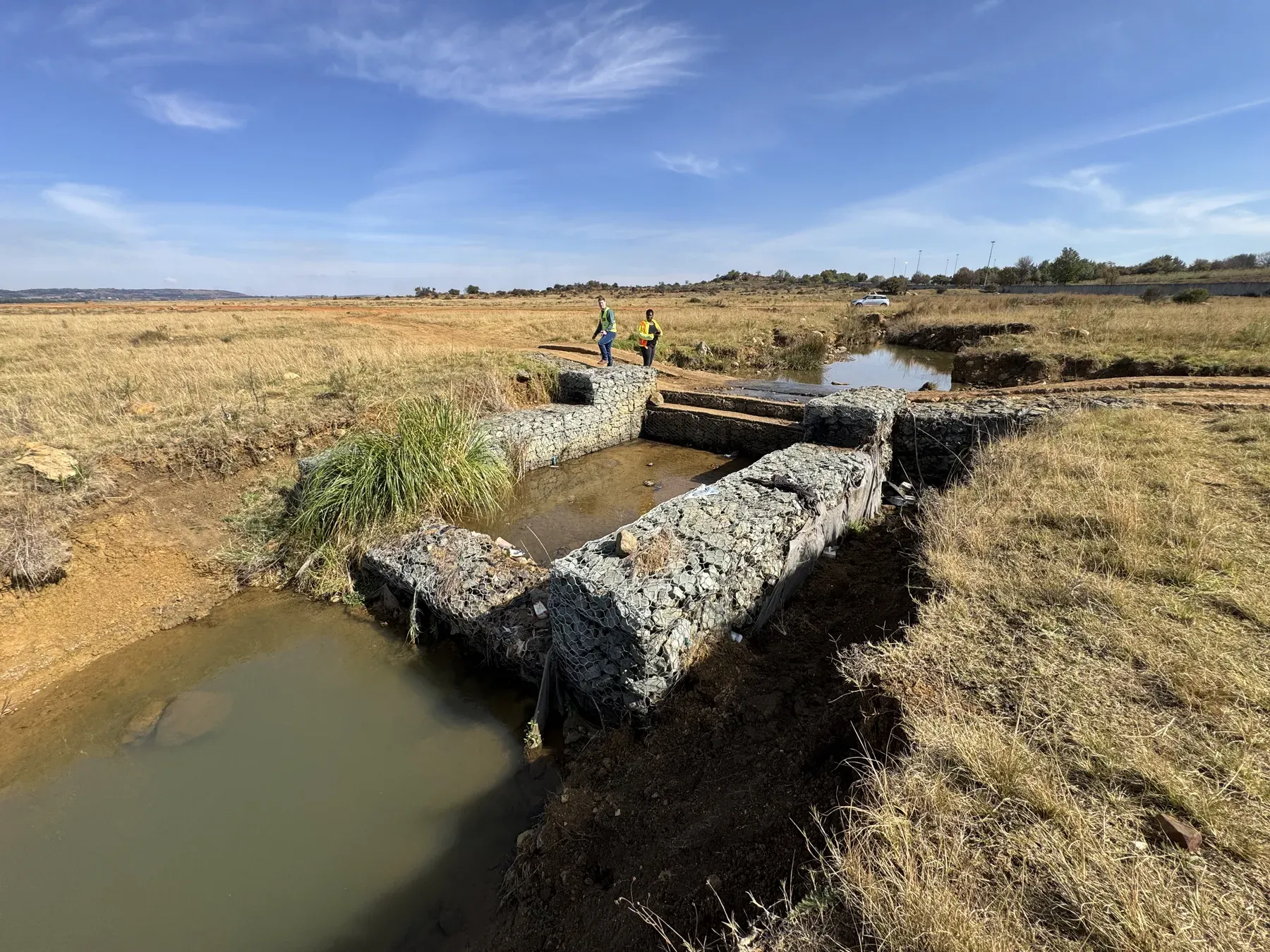
- Wire corrosion, especially in aggressive or saline water, which eventually frees the rock fill.
- Abrasion from sediment-laden flow sawing through the mesh at high-velocity points.
- Vandalism and theft of the wire and stone — a real and recurring problem on South African sites.
A gabion is only a coherent structure while its mesh is intact; once the wire goes, it is just a loose pile of rock in the flow, and it behaves like undersized riprap.
What early failure looks like on site
The value of catching it early is enormous, and the warning signs are consistent: a slumped or displaced downstream edge; a scour hole at the toe; rock migrated downstream of where it was placed; bulging or sagging gabion baskets as fill shifts; and fines deposited downstream — the tell-tale of a filter that is letting soil through. None of these is a collapse yet. All of them are the collapse beginning.
Rehabilitate or rebuild
Once protection has started to fail, the decision is whether a targeted repair — re-establishing the toe, fixing the termination, adding the missing filter — restores the system, or whether the underlying design was wrong and it needs rebuilding to a proper specification. That call depends on why it failed, which is exactly what a proper assessment establishes rather than assumes. Getting the diagnosis right matters, because rebuilding to the same flawed detail simply buys another failure. Related structural issues often show up together with erosion at culvert outlets and around bridge crossings.
See our scour and erosion protection service for design and failure assessment, or get in touch if protection on your site is showing any of the early signs above.
Working on a site where flooding, stormwater, or floodlines are a concern? Send us a message about it and we’ll reply within one business day — no obligation.
Talk to an engineer