


Post-Event Loss Modelling: From Flood Footprint to Portfolio Impact
· Written by Robert Fortuin · Reviewed by Stephan Dreyer
When a major flood hits, an insurer’s first question is not “what will happen” — it is “what just happened to us.” Post-event loss modelling is the discipline of turning a flood that has already occurred into a fast, defensible estimate of portfolio impact, in the days and weeks when claims are still coming in and reserves have to be set. The challenge is that speed and rigour pull in opposite directions, and the value is in doing both.
Just been hit by a major flood event? We reconstruct the footprint and overlay your book to give an early, evidence-based loss estimate — before all the claims are in.
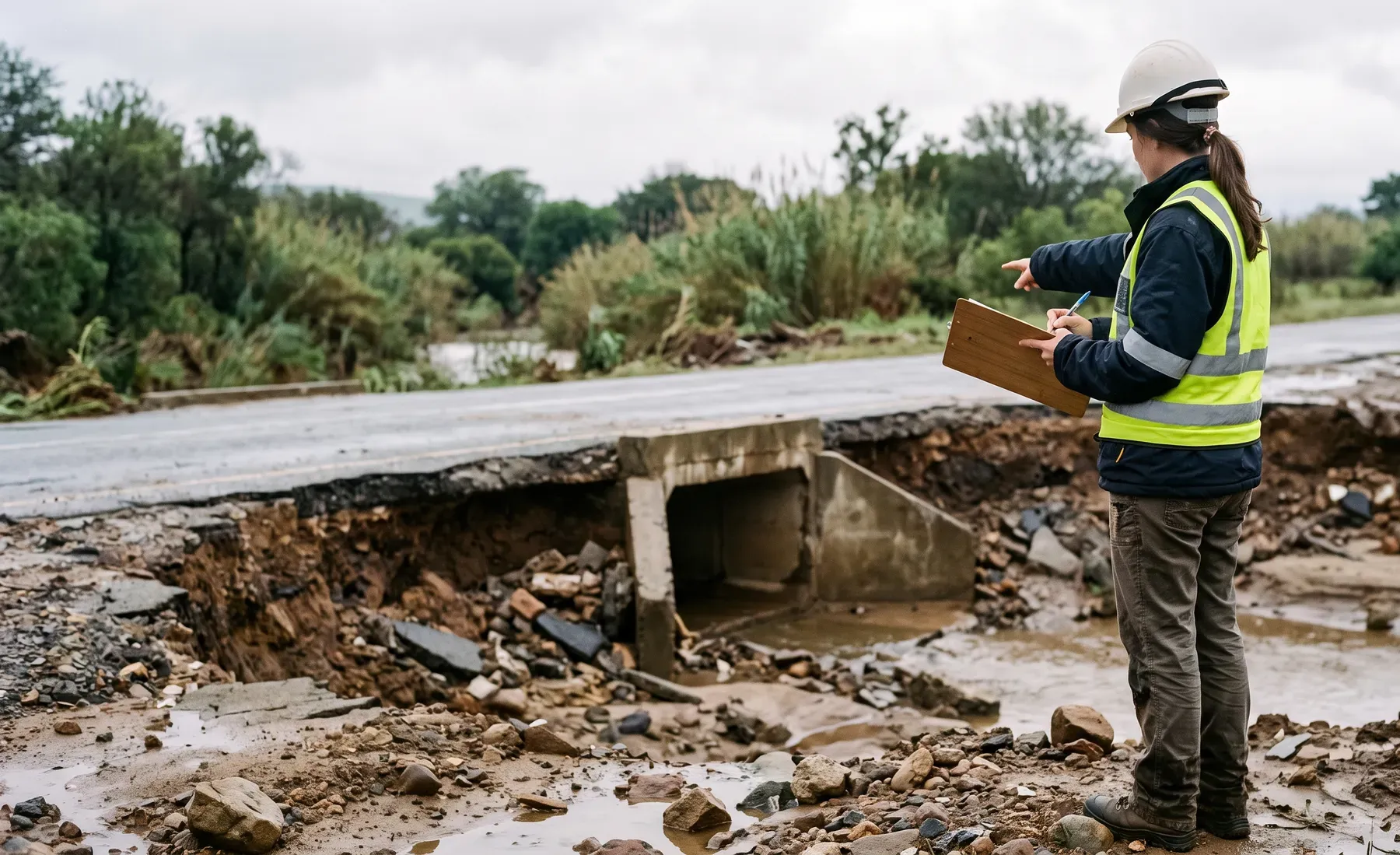
Flood damage assessmentStep one: reconstruct the flood footprint
The starting point is what actually flooded — the event footprint. In the immediate aftermath this is assembled from whatever is available fastest: satellite and radar imagery of the inundation, gauge peaks, rainfall records, and on-the-ground reports. Early footprints are coarse and get refined as better data arrives, but even a first-pass footprint anchors everything downstream. The footprint is the event-specific counterpart to a return-period hazard map — it is this flood, not a hypothetical one.
Step two: overlay the exposure
The footprint is then overlaid on the insured exposure — the portfolio’s locations, values, and characteristics. This is where geocoding quality shows: precisely located exposure gives a precise overlay, while addresses that resolve only to a suburb centroid smear the answer. The overlay identifies which policies sit in the flooded area and, crucially, the estimated flood depth at each affected property, since depth drives loss.
Step three: estimate the loss
Applying vulnerability (damage) functions to the depth at each property converts the footprint-and-exposure overlay into a monetary loss estimate for the portfolio. This is the same machinery as a reinsurance-grade loss model, but pointed at a single real event rather than a distribution of possible ones. The output is an early, evidence-based loss estimate that reserving and reinsurance-recovery decisions can start from, well before individual claims are all in.
Step four: refine as claims and data arrive
Post-event modelling is not a single report — it is a cadence. As the footprint sharpens, as claims data flows in, and as ground-truth becomes available, the estimate is updated and the modelled loss is reconciled against actual claims. That reconciliation does double duty: it tightens the current event’s estimate, and it calibrates the model for the next one. Each event a model is tested against makes it more trustworthy.
Why speed and rigour are not in conflict
The instinct is to treat the fast early estimate as rough and the rigorous one as slow, but a well-built workflow gives you both by being transparent about uncertainty at each stage. An early estimate with an honest range is more useful for setting reserves than a precise-looking number that lands weeks later. The rigour is in the method and the documentation, not in waiting — which is what lets the estimate be both quick and defensible.
The connection to claims and recovery
Because it is grounded in a real footprint and real depths, post-event modelling also supports the individual claims and dispute side — the same hydraulic evidence that estimates portfolio loss can defend or interrogate a specific claim. The portfolio view and the property view are two uses of one underlying reconstruction of the event.
See our post-event loss modelling offering for how we run the cadence after a named event, or get in touch if you need a rapid, defensible impact estimate after a flood.
Working on a site where flooding, stormwater, or floodlines are a concern? Send us a message about it and we’ll reply within one business day — no obligation.
Talk to an engineer