

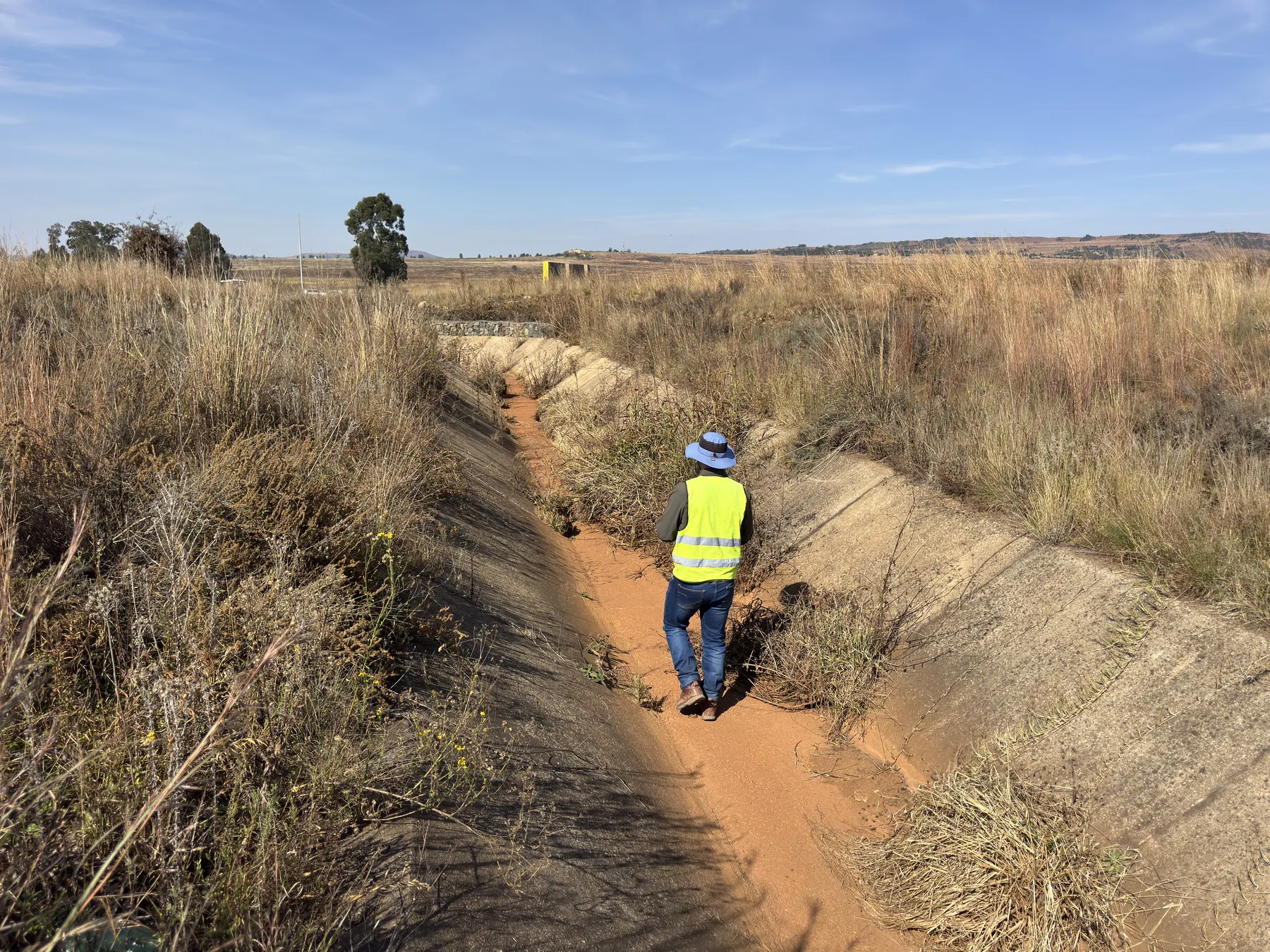
Silted-Up Stormwater Canals: How Sediment Quietly Erases Design Capacity
· Written by Robert Fortuin · Reviewed by Stephan Dreyer
A stormwater canal is designed once, for a clean cross-section, and then left to fill up. Years later it floods a road or a property, and everyone is surprised — because the canal “looks fine” and was ostensibly maintained. The problem is that the canal it was designed to be no longer exists. Sediment and vegetation have quietly rebuilt it into a smaller, rougher channel, and the capacity loss is worse than the visible loss of space suggests.
Canal flooding a road that ought to have capacity? We survey the section that is actually there and re-assess against it — the drawings stopped being true years ago.
Stormwater management plansThe canal was designed for a section that no longer exists
Design capacity assumes the as-built section — the full width, the design depth, and the smooth lining that was specified. Every year of deposited silt, sand, and encroaching vegetation moves the canal away from that assumption. By the time it floods, the effective channel can be substantially smaller and much rougher than the one on the drawings, and nobody re-checked the capacity against the section that is actually there.
Why 30% section loss is far worse than 30% capacity loss
Here is the part that surprises people. Channel capacity does not scale one-for-one with cross-sectional area, because it depends on the flow area and the roughness and the hydraulic geometry together. Two things happen at once as a canal silts up:
- The flow area shrinks — that alone cuts capacity.
- The roughness rises sharply — silt, sediment, and especially vegetation are far rougher than a clean concrete or earth lining, and higher roughness cuts the velocity the channel can achieve for the same slope.
Because capacity is the product of a shrinking area and a falling velocity, a canal that has lost, say, 30% of its section to sediment and reeds has typically lost considerably more than 30% of its capacity. The two effects compound. This is why a canal can look “half full of reeds” and yet be running at a small fraction of its design flow.
Quantifying it with a quick survey and model
Turning “it looks silted” into a defensible number is straightforward: survey the canal as it exists now — the real, reduced section and the actual surface condition — and model its capacity with realistic roughness against the design flood. The output is the flow the canal genuinely conveys today versus what it was built to convey. That gap is the maintenance backlog, expressed as a number rather than an impression, and it is the same hydraulic capacity check we run on culverts and bridges.
Prioritising maintenance spend across a network
No municipality can clear every canal at once, so the real question is which ones, in what order. Assessing capacity across a network turns maintenance from a reactive, complaint-driven exercise into a prioritised programme: the canals whose lost capacity puts the most people or property at risk get cleared first. This is exactly the kind of decision a stormwater management plan is meant to support at network scale.
Responsibility and liability when a “maintained” canal floods
When a silted canal floods and causes damage, the maintenance history becomes the central question. A canal that was genuinely maintained but is simply undersized for a developed catchment is a different liability position from one that was allowed to silt up and lose the capacity it had. Being able to show what capacity the canal actually had — and when that was last verified — is what turns an argument into evidence, which is why the survey-and-model record matters beyond the engineering. A post-event flood damage assessment frequently turns on precisely this distinction.
See our stormwater management plans and surface water management services for network capacity assessment, or get in touch if a canal on your network keeps flooding despite looking maintained.
Working on a site where flooding, stormwater, or floodlines are a concern? Send us a message about it and we’ll reply within one business day — no obligation.
Talk to an engineer